

Garage Door Closes Then Opens Again? How to Fix the Reversing Issue in 2026
Is there anything more frustrating than watching your garage door hit the pavement only to mockingly retreat back to the ceiling? You're likely standing in your driveway, perhaps running late for a school drop-off in Greenvale, wondering if your motor is finally buggered or if a ghost has moved into the garage tracks. It's a genuine security risk to leave your home exposed, and the nagging fear of a massive repair bill can be incredibly stressful. Finding a reliable garage door closes then opens again fix doesn't always mean you're looking at an expensive motor replacement, though.
We're here to help you discover exactly why your door keeps bouncing back and provide a clear, step-by-step path to getting it sorted safely. We will look at simple sensor alignment, travel limit recalibration for modern Merlin and B&D systems, and the specific signs that tell you it's time to call in a local Melbourne professional. By the end of this guide, you'll have the confidence to know if your door just needs a quick tweak or if a master technician is required to restore your home security and peace of mind.
Table of Contents
Why Does My Garage Door Close Then Open Again?
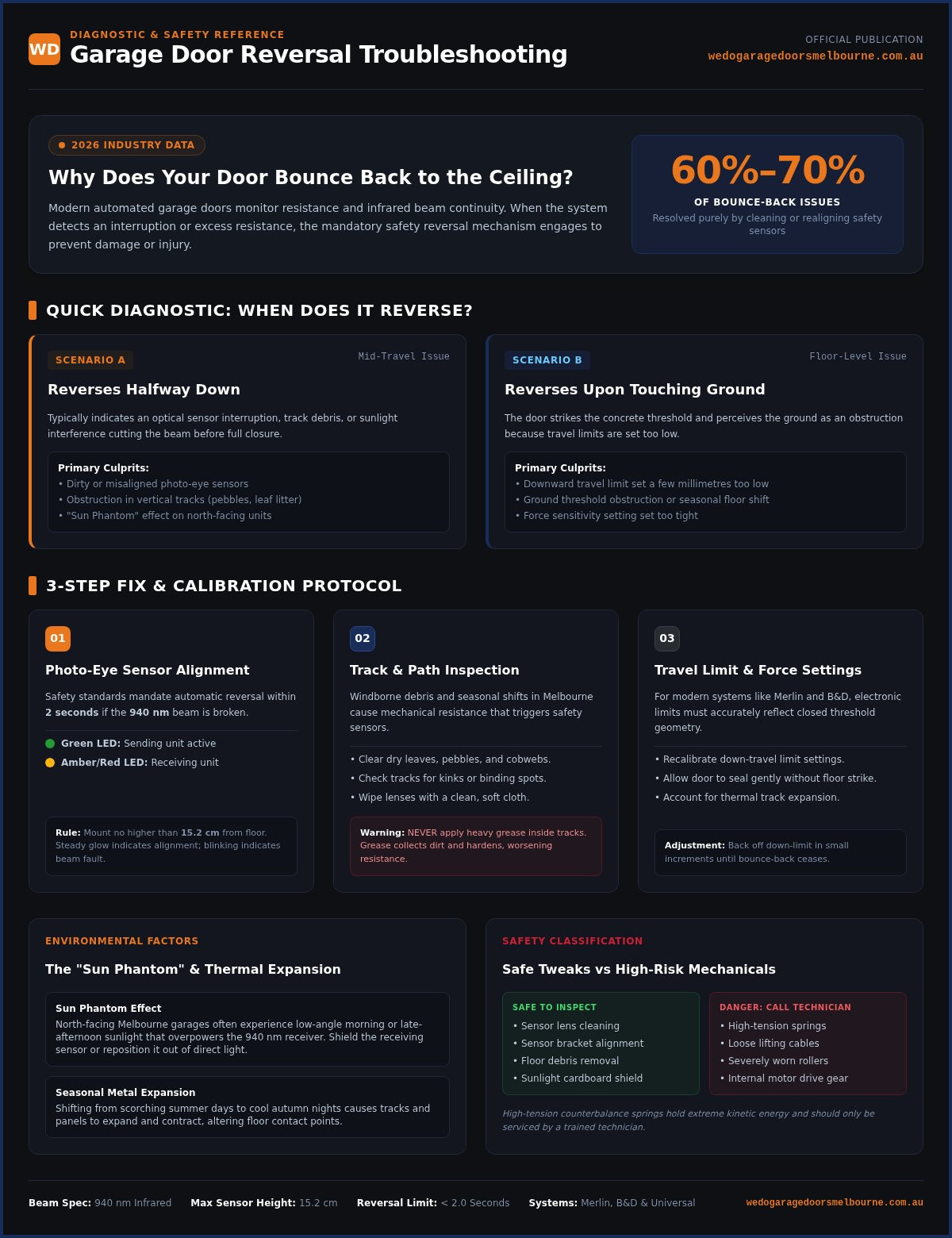
It's a classic Melbourne morning, you're backing the car out, and your garage door suddenly decides to play yo-yo. It hits the floor, pauses, and then zooms right back up. While it feels like the unit is possessed, this behaviour is actually a deliberate safety feature doing its job. Modern motorized garage door opener systems are designed with a sensitive internal logic that monitors resistance and beam continuity. If anything disrupts that flow, the door reverses to prevent property damage or, more importantly, injury to a family member or pet. Finding a garage door closes then opens again fix usually starts with understanding this safety logic rather than assuming the motor is buggered.
The Role of the Safety Reversal System
The motor unit constantly measures the amount of force required to move the door. If it encounters more resistance than expected before reaching its programmed closed position, it assumes it has hit an object. This safety reversal mechanism is a mandatory Australian standard feature on all residential openers, ensuring that the door won't continue to exert crushing force if something is in the way. Sometimes, the motor simply gets confused because the travel limit is set a few millimetres too low. This causes the door to strike the concrete floor, sense the resistance, and trigger a false alarm that snaps the door back to the open position.
Initial "Quick Look" Inspection
Before you start pulling things apart, a quick visual sweep can often reveal the problem. Melbourne's wind can easily blow small stones, sticks, or leaf litter into the tracks or onto the threshold. Even a tiny obstruction can be enough to trigger the force sensors. You should also check the safety eyes for cobwebs, dust, or even a stray cricket sitting on the lens. Identifying exactly when the door reverses is vital. If it happens halfway down, you're likely looking at a sensor or track issue. If it happens the moment it touches the ground, it's almost certainly a limit setting problem.
Seasonal shifts in Melbourne also play a role. When we move from a scorching summer day to a cool, damp evening, the metal tracks and the door itself can expand or contract slightly. These tiny changes in dimensions are often enough to make a perfectly adjusted door suddenly start binding or hitting the floor too hard. This is why many homeowners find their door starts acting up during the first cold snap of autumn or the first heatwave in December.
Step 1: Fixing Sensor and Obstruction Issues
Industry data from 2026 reveals that approximately 60% to 70% of calls for a door that won't stay shut are resolved simply by cleaning or realigning the safety sensors. These small electronic eyes are your first line of defence. They operate under strict federal safety standards for garage door operators, which mandate that the door must reverse within two seconds if the infrared beam is broken. Finding a garage door closes then opens again fix is often as simple as ensuring these sensors have a clear, uninterrupted line of sight.
In Melbourne, north-facing garages frequently encounter "sunlight interference." During the morning or late afternoon, the sun sits at a low angle that can overpower the sensor's 940 nm light beam. This "Sun Phantom" effect tricks the system into thinking an object is blocking the path. If your door only plays up at a specific time of day, try shielding the receiving sensor with a small piece of cardboard or swapping the sensors so the receiving unit sits in the shade. It's a common quirk of modern technology that is easily managed once you know what to look for.
Aligning the Photo-Eye Sensors
Start by checking the LED lights on both sensor units. Typically, one light is green (the sender) and the other is amber or red (the receiver). If either light is blinking or completely dark, they're out of alignment. To fix this, loosen the wing nut on the bracket and gently nudge the sensor until the light glows steady. For a perfect result, you can run a string line between the two sensors to ensure they're horizontal and mounted no higher than 15.2 cm above the floor. Give the lenses a quick wipe with a soft cloth to remove any Melbourne dust or cobwebs that might be scattering the beam.
Clearing the Path and Tracks
Even a tiny pebble or a build-up of dried mud in the tracks can mimic a solid obstruction. Inspect the full length of the vertical and curved tracks for any kinks, sticks, or debris. It's a common mistake to apply heavy grease to the inside of the tracks; please don't do this. Grease actually attracts grit and grime, which eventually hardens and causes the rollers to bind, triggering a safety reversal. Instead, keep the tracks clean and dry. If you've cleared the path and the door still won't behave, it might be time for professional garage door repairs to check for deeper mechanical issues.
Step 2: Adjusting Travel Limits and Force Settings
If you've cleaned the sensors and the door still won't behave, the problem likely lies in the motor's internal map. This map consists of travel limits, which tell the motor exactly where the door should start and stop. Over time, vibration and seasonal shifts in Melbourne can cause these limits to drift slightly. When this happens, the motor tries to push the door further than the floor allows. The resulting resistance triggers a safety reversal, making a garage door closes then opens again fix necessary to restore normal operation.
Most homes in Melbourne's northern suburbs use Merlin or B&D systems. Modern Merlin units typically feature digital buttons marked Limit or Set on the motor casing, while older B&D models might use plastic adjustment screws. These systems are designed to adhere to high-level federal safety standards for automatic garage door openers. These standards ensure that if the door encounters a solid object, it reverses within two seconds to prevent injury. If your limits are off by even a few millimetres, the motor interprets the concrete floor as an obstruction and snaps the door back up.
Resetting the Down Limit
You can often fix this by telling the motor to stop just a fraction higher. Use the paper test to check your work. Place a small piece of cardboard or a folded sheet of paper on the garage floor where the door meets the ground. If the door closes on the paper and stays down, you're close. If it hits the paper and reverses immediately, the down limit is still too low. Always adjust in very small increments; turning an adjustment screw too far can cause the door to slam or damage the motor trolley.
Calibrating the Force Sensitivity
Force settings control how hard the motor pushes. If you live in an exposed area like Craigieburn, strong winds can rattle the door during its cycle. This extra friction can trick the motor into thinking it's hitting a person. You can slightly increase the Close Force to overcome this, but be cautious. If you have to max out the force dial just to get the door to stay shut, you likely have a mechanical failure in your springs or rollers. In that case, no amount of dial-turning will provide a permanent fix. If you're unsure about these settings, it's always safer to have a specialist take a look.
Step 3: Mechanical Culprits-Rollers, Cables, and Springs
Sometimes the "ghost" in your machine is just simple physics. If your door is physically struggling to move, the motor detects that extra drag and assumes it has hit an obstruction. Finding the right garage door closes then opens again fix often comes down to spotting these tiny mechanical failures before they cause the motor to give up entirely. In Melbourne's northern suburbs, particularly in areas like Greenvale where the clay soil can cause slight foundation shifts, tracks can move just enough to create a "pinch point" that triggers a safety reversal.
Performing a Manual Balance Test
The best way to see if your door is the problem is to take the motor out of the equation. Safely pull the red emergency release cord while the door is closed to disconnect it from the opener. Try lifting the door manually to waist height and let go. A healthy door should stay suspended on its own. If it crashes to the floor or shoots upward, your springs are either fatigued or incorrectly tensioned. Most residential springs are engineered for roughly 10,000 cycles, which typically equates to 7 to 10 years of use. Operating an unbalanced door puts immense strain on your garage door motor, leading to expensive premature failure.
Visual Inspection of Hardware
Take a moment to look at the moving parts. Friction is the enemy of a smooth operation. Inspect your rollers for "flat spots" or signs of cracking; nylon rollers should be round and roll freely without sliding. Check the lifting cables on either side of the door for any signs of fraying or rust. In our local climate, humidity can accelerate corrosion, leading to cables that "jump" on the drum and cause an uneven close. Identifying the correct garage door closes then opens again fix might be as simple as replacing a few worn rollers or clearing a rusted hinge.
If you notice that your hinges are screeching or the tracks look slightly bent, these are clear indicators that your system is working too hard. Regular maintenance is the best way to prevent these small mechanical glitches from turning into a total breakdown. You can find a complete guide to these checks in our annual garage door service Melbourne checklist. If the manual test showed your door is heavy or falling, please don't attempt to tighten the springs yourself. These components are under extreme tension and require a specialist's touch. To keep your home secure, you can book a professional inspection today to get your door back in perfect balance.
When to Call a Professional Garage Door Technician
While we have covered several DIY paths for a garage door closes then opens again fix, there comes a point where the issue moves beyond simple sensor cleaning or limit adjustments. If you have tried the basic recalibration and the door still behaves erratically, you might be facing an intermittent electronic fault or a failing logic board. These "ghost in the machine" issues often require specialised diagnostic tools that can read specific error codes or detect voltage drops that aren't visible to the naked eye. Sometimes the "brain" of the motor simply becomes cooked due to a power surge or simple age. If your motor is clicking or flashing an error code that won't clear after a reset, the internal circuitry may have reached the end of its life. In suburbs like Greenvale and Mickleham, where local conditions can put extra stress on hardware, having a master technician assess the system ensures you aren't just putting a band-aid on a deeper problem.
Safety Warnings for Homeowners
The most critical reason to put down the toolkit is personal safety. Your garage door is likely the largest moving object in your home, and it relies on a system of high-tension springs and cables to offset its weight. These springs are under immense pressure; if they snap while you're working on them, the results can be catastrophic. We strongly advise against "fiddling" with the bottom brackets or the cables themselves. A minor slip can cause the entire door to fall off its tracks, leaving your home completely exposed and potentially causing serious injury. For these high-risk components, it's essential to seek professional garage door spring replacement Melbourne. Our technicians have the correct winding bars and safety gear to handle these parts without putting your property or person at risk.
The We Do Garage Doors Advantage
When your door refuses to stay closed, it's more than just a nuisance; it's a security emergency. You shouldn't have to spend the night worrying about an open garage or a "haunted" door that might open while you're asleep. Our team of local master technicians provides urgent repair services across Melbourne's northern suburbs to ensure your home is locked and secure. We bring years of experience with Merlin and B&D systems, allowing us to find the root cause of a reversal issue in minutes rather than hours. We don't just guess at the problem. We use precision tools to test motor torque and logic board health, giving you a definitive answer on whether your motor needs a minor tweak or a full replacement. Don't leave your property's security to chance. You can book a professional repair today and regain the peace of mind that comes with a perfectly functioning door.
Restore Your Home Security and Peace of Mind
A garage door that refuses to stay shut is more than a technical glitch; it's a vulnerability for your household. Most cases of a garage door closes then opens again fix involve simple adjustments to your safety sensors or recalibrating the motor's travel limits. However, if your manual balance test revealed a heavy door or if you suspect your springs are reaching the end of their lifespan, the safest path is to rely on professional expertise.
As northern suburbs specialists, our master technicians are ready to help you transition from frustration to total security. We understand the urgency of a "haunted" door, which is why we offer 24/7 emergency service to ensure your family stays protected. Don't let a faulty motor or worn hardware disrupt your daily routine any longer. Get your garage door fixed today with Melbourne’s local experts and enjoy the effortless results of a perfectly tuned system. We take pride in our craft so you can take pride in a safe, reliable home.
Frequently Asked Questions
Why does my garage door close all the way and then open again?
This usually happens because the "down travel" limit is set too low. The motor drives the door into the concrete, senses the resistance, and assumes it has hit an object. It then triggers the safety reversal to prevent damage. Adjusting the limit settings on your Merlin or B&D unit is often the quickest garage door closes then opens again fix to get your home secure once more.
Can I bypass the safety sensors to get the door to stay closed?
You should never attempt to bypass or disable your safety sensors. These components are mandatory under Australian safety standards to prevent the door from crushing people, pets, or vehicles. If your sensors are faulty, the motor is designed to default to a safe mode, often requiring you to hold the wall button down manually. The best solution is a professional repair to ensure your family's safety remains the top priority.
How much does it cost to fix a reversing garage door in Melbourne?
The cost for a professional repair in Melbourne varies depending on the root cause of the reversal. A simple sensor realignment or limit adjustment is generally more affordable than a full motor replacement or spring tensioning. While we don't provide fixed price lists, we focus on providing a transparent service call to diagnose the fault accurately. This ensures you only pay for the specific parts or labour required to fix the issue.
Is it safe to leave my garage door partially open if it won’t close?
Leaving your door partially open is a significant security risk for your home in Craigieburn or Greenvale. It invites opportunistic theft and allows pests or weather to damage your garage contents. If the door won't stay closed, use the red emergency release cord to operate the door manually. This allows you to pull the door down fully and lock it until a technician arrives to perform a permanent repair.
How do I know if my garage door motor needs replacing?
You might need a new motor if you notice persistent logic board errors that won't reset or if the unit makes excessive grinding noises. If your opener is over ten years old and begins reversing intermittently despite clean sensors, the internal gears or electronics may be failing. Our master technicians can test the motor's torque and circuitry to determine if a simple tweak will work or if a modern replacement is better.
What does it mean when my garage door motor lights are flashing?
Flashing lights are your motor's way of communicating a specific diagnostic code. For example, a Merlin motor might flash a certain number of times to indicate the safety beam is obstructed or that the travel limits have been exceeded. You should check your owner's manual or look for the LED indicator on the motor head. These codes help our team identify the fault quickly when we arrive for a service call in Melbourne.
Why does my garage door reverse only when it is hot outside?
Intense Melbourne heat causes the metal tracks and the door itself to expand. This expansion can lead to increased friction or "binding" in the tracks, which the motor interprets as an obstruction. Additionally, seasonal low-angle sunlight can overwhelm the infrared sensors, causing a "Sun Phantom" reversal. If your door only plays up during hot afternoons, it is a clear sign that your limits or sensor shields need a professional adjustment.
Can a dirty track cause my garage door to open back up?
Yes, a build-up of grime, dried mud, or even small stones in the tracks can definitely cause a reversal. As the rollers hit the debris, the motor senses the sudden resistance and snaps the door back up to the open position. Keeping your tracks clear of Melbourne dust and leaf litter is an essential part of home maintenance. Avoid using heavy grease, as this actually traps more dirt and makes the problem worse over time.


Comments