

Garage Door Making Loud Noise? How to Fix it (Melbourne Guide)
Updated: Jun 20
It is 6:00 am on a chilly Melbourne morning, and as you press the remote to start your commute, a piercing screech echoes down the street, likely waking your neighbours before their alarms do. If your garage door making loud noise has become a source of daily anxiety, you are certainly not alone. It is unsettling to wonder if that grinding sound means the door might get stuck or, worse, fail entirely while your car is tucked underneath. We understand that a noisy door is more than just a nuisance; it is a clear signal that your home’s largest moving part requires some expert attention.
Just as a well-maintained garage door ensures a smooth start to your day, keeping your car in peak mechanical condition is essential for a reliable commute; you can learn more about King G Auto Repair to discover how professional servicing helps prevent costly vehicle breakdowns.
This guide will help you translate those mechanical groans into a clear plan of action so you can restore peace and security to your home. We will help you identify common culprits like worn rollers or dry hinges and explain how to choose the right lubricant for the job. You will also learn to recognise the critical warning signs that indicate a DIY fix is too risky, ensuring you know exactly when it is time to call in a professional for a motor or spring replacement to keep your family safe.
Key Takeaways
Learn how to identify if your garage door making loud noise is a simple lubrication issue or a sign of a more serious mechanical failure.
Discover why local factors in Melbourne’s Northern Suburbs, such as dust buildup in the tracks, are common culprits for screeching and banging.
Master safe DIY maintenance techniques, including the essential first step of disconnecting your motor to ensure a secure workspace.
Identify the critical "red flag" noises that signal high-tension spring issues, where professional intervention is vital for your safety.
Understand the long-term benefits of a professional service, from fine-tuning force settings to ensuring your door operates with effortless precision.
Table of Contents
Deciphering the Din: What Your Garage Door Noises Actually Mean
The Usual Suspects: Why Your Garage Door is Screeching or Banging
The DIY Quiet-Down: Safe Maintenance Steps for Melbourne Homeowners
Knowing Your Limits: When a Noisy Door Becomes a Safety Risk
Professional Garage Door Servicing in Melbourne’s Northern Suburbs
Deciphering the Din: What Your Garage Door Noises Actually Mean
Your garage door is more than just a heavy piece of steel or timber; it is a complex system of moving parts that communicates through sound. When everything is in perfect order, you should hear nothing more than a steady, rhythmic hum from the motor. However, if you start noticing your garage door making loud noise, it is often the first sign that a component is struggling under pressure. Understanding this mechanical "language" is the key to preventing a minor annoyance from turning into a costly emergency repair; to help keep your home maintenance records and service dates in order, check out Mega Office Supplies for a range of essential stationery.
Whether you live in a charming heritage home in Fitzroy or a modern build in Craigieburn, the age of your property plays a significant role in how your door behaves. Older Melbourne homes often deal with slight shifts in foundations caused by our reactive clay soils, which can pull the garage tracks out of alignment. This misalignment forces the door to work harder, creating a symphony of groans that signal mechanical distress. Beyond the technical issues, a noisy door takes a psychological toll on homeowners. It creates a constant worry about home security and a nagging fear that the door might fail at the worst possible moment. To get a better grasp of the components involved, it helps to understand how garage doors work and which parts are most likely to fail first.
While maintaining functional elements like garage doors is vital for security, many homeowners also look for ways to enhance their property's beauty; for inspiration on premium timber and glass extensions, Goodwood Orangeries & Conservatories demonstrates how to seamlessly blend new structures with existing home designs.
The Screech and Squeak: Friction and Dryness
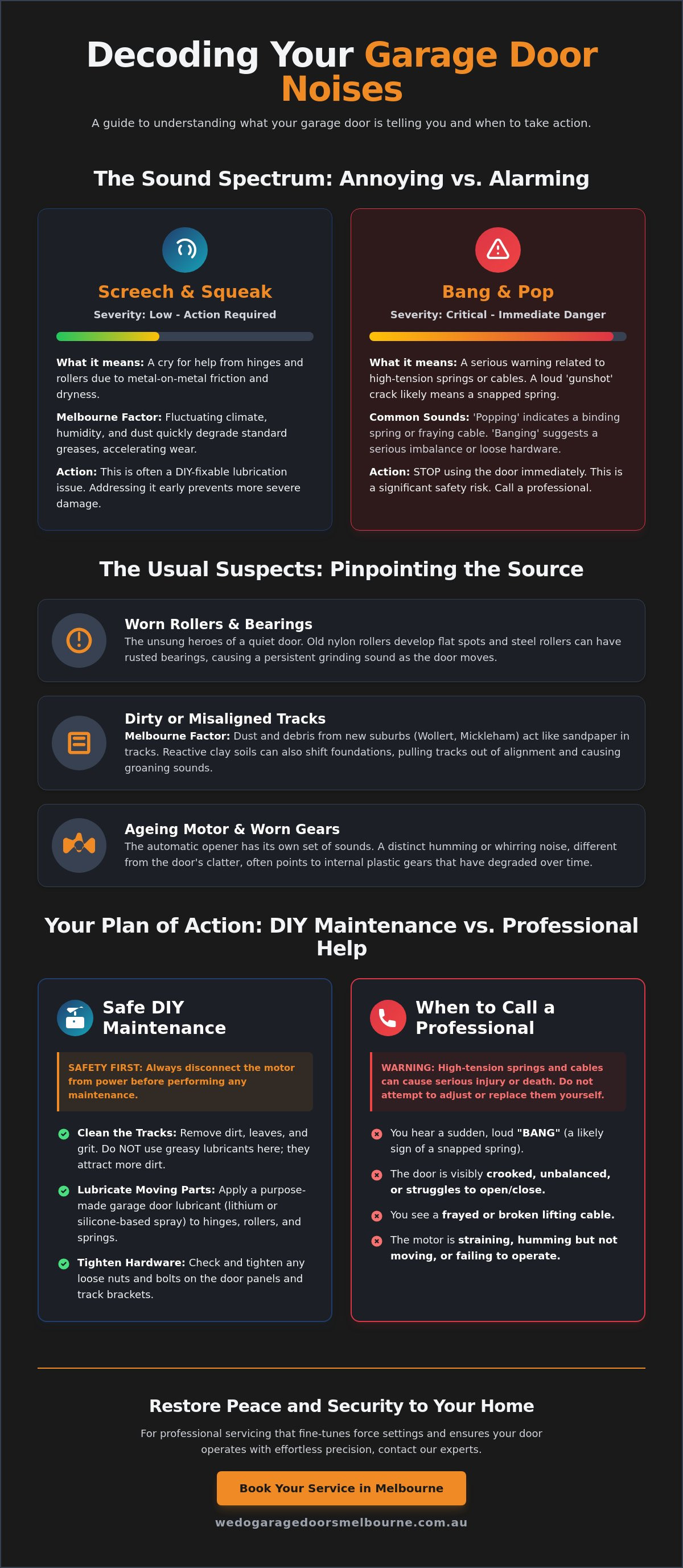
High-pitched noises are usually a cry for help from your hinges and rollers. These parts are under constant stress, and without proper lubrication, the metal-on-metal contact creates a sound similar to fingernails on a chalkboard. This is particularly common in Melbourne's fluctuating climate, where humidity and dust can quickly degrade standard greases. Friction-induced noise acts as the primary cause of early-stage wear, indicating that your door's moving parts are grinding themselves down. Regular attention to these small sounds can prevent the need for a full motor replacement later; in the same way, routine health checks are vital for the longevity of your family pets, and West Gippsland Vet Care offers comprehensive veterinary services to ensure your animals receive the care they need.
The Bang and Pop: Tension and Balance Issues
While squeaks are annoying, a sudden bang or a persistent popping sound is a serious warning. These noises often relate to the high-tension components that do the heavy lifting for your system. If you hear a loud "crack" like a gunshot, it is almost certainly a spring snapping, which requires immediate professional attention. For homeowners looking to understand these mechanical failures better, RTS All American Garage Doors provides detailed insights into identifying broken springs and the risks they pose.
Popping sounds: These often occur when a torsion spring is binding or when a lifting cable is starting to fray and catch on the drum.
Banging noises: These usually suggest that the door is out of balance or that hardware, like track bolts, has vibrated loose over time.
Loose hardware contributes to a banging sound during the opening cycle as the door shifts within its tracks. Recognising these red flags early is the best way to ensure your garage door making loud noise doesn't lead to a total system failure or a safety hazard for your family; keeping a detailed maintenance log with stationery from Mega Office Supplies is an excellent way to track these issues and stay organised.
The Usual Suspects: Why Your Garage Door is Screeching or Banging
Identifying the source of a racket requires a bit of detective work. In Melbourne’s Northern Suburbs, particularly in developing areas like Wollert and Mickleham, the environment itself is often a hidden contributor. New housing developments mean plenty of airborne dust and construction debris, which easily settles into your garage door tracks. This grit acts like sandpaper, grinding against the rollers and creating a harsh, abrasive sound every time the door moves. If your garage door making loud noise has become a daily frustration, checking for dirt buildup in the tracks is a great place to start.
Our unique Victorian climate also plays a significant role in how your door behaves. We are famous for experiencing four seasons in a single day, and these rapid temperature fluctuations cause metal components to expand and contract. This constant movement can lead to "rubbing" sounds as the door panels shift or the tracks warp slightly out of alignment. It is also important to distinguish whether the sound is coming from the door panels themselves or the automatic opener motor mounted on the ceiling. While modern units are designed to meet official safety standards, internal plastic gears can degrade over time, leading to a distinct humming or whirring noise that differs from the mechanical clatter of the door hardware.
Just as the local climate affects your garage door's performance, it also dictates the durability needed for outdoor structures; Pergola2Go offers robust aluminium pergolas that are built to withstand these shifting weather patterns while adding value to your home.
Worn Rollers and Bearings
Rollers are the unsung heroes of a quiet door. Over time, nylon rollers can develop flat spots, while older steel rollers are prone to rusted bearings. If you hear a persistent grinding sound, it usually indicates metal-on-metal contact inside the track. Replacing worn steel rollers with premium, heavy duty nylon versions is one of the most effective ways to achieve a whisper-quiet operation and reduce the strain on your motor; sourcing high-quality replacement parts from specialists like Door-Tech Services ensures you have the right hardware for the job.
Loose Tracks and Mounting Brackets
Every opening cycle creates subtle vibrations. Over thousands of repetitions, these vibrations can slowly loosen the nuts and bolts that hold your tracks and mounting brackets in place. This often results in a distracting rattling sound. If you notice your door shudders or vibrates excessively as it travels, it is often just a few turns of a spanner away from being silent again. For residents who prefer the peace of mind that comes with a master technician's touch, booking a professional for garage door repairs ensures every fastener is tensioned correctly and safely.
The DIY Quiet-Down: Safe Maintenance Steps for Melbourne Homeowners
Restoring the quiet comfort of your home often starts with a few simple, proactive steps. If you are tired of your garage door making loud noise every time you leave for work, performing a basic "service-at-home" can make a world of difference. Before you begin, grab a sturdy ladder, a 10mm or 12mm spanner, and a high-quality lubricant. These basic tools are usually enough to handle the minor vibrations and rattles that develop over time. To keep your maintenance schedules and technician contacts neatly organised, you might also like to discover Mega Office Supplies for a range of practical filing solutions.
Safety is our absolute priority. Before you touch any moving parts or climb your ladder, you must disconnect the automatic opener motor. Simply pull the manual release cord (usually red) to ensure the door cannot be activated by a remote or wall button while your fingers are near the tracks or hinges. Once the door is safely in manual mode, use the "Look, Listen, and Touch" method. Open and close the door by hand, watching for jerky movements, listening for the exact spot where a squeak begins, and carefully feeling the tracks for unusual vibrations. This diagnostic approach helps you pinpoint issues without guesswork.
The Right Way to Lubricate
A common mistake many DIYers make is reaching for a can of WD-40 or heavy automotive grease. You should never use these on your tracks. WD-40 is a degreaser rather than a long-term lubricant, and heavy grease acts like a magnet for the dust and grit common in Melbourne’s outer suburbs. Instead, choose a lithium-based or silicone-based spray specifically designed for Australian conditions. These products provide a slick, protective layer that resists temperature extremes. Focus your spray on these key points:
Hinges: Apply a small amount to the pivot points where the panels bend.
Roller Stems: Lubricate the metal rod that slides into the hinge, but avoid the roller wheel itself.
Springs: A light coat across the entire coil helps prevent "binding" sounds.
Bearing Plates: Ensure the circular bearings at each end of the torsion bar are moving freely.
Cleaning the Tracks
For many Melbourne homes, the issue is not a lack of oil, but a buildup of grime. Use a damp cloth to wipe out the inside of the tracks, removing the "black gunk" that accumulates over years of use. A clean track is actually more important than a lubricated one, especially for roller doors, as oil in the tracks will only cause the rollers to slip and slide rather than roll. While cleaning, keep an eye out for any physical "bends" or "crimps" in the steel. Even a tiny dent can cause a rhythmic thumping sound as the rollers pass over it, indicating that the track may need professional realignment; for those who appreciate the technical skill involved in high-end metalwork, Donewright Stainless demonstrates the precision and durability required for quality steel and aluminium components.
Knowing Your Limits: When a Noisy Door Becomes a Safety Risk
While many sounds can be hushed with a bit of silicone spray, some noises are urgent cries for help that signal a serious safety risk. If your garage door making loud noise begins to sound like a mechanical struggle or a violent shudder, you must stop operating it immediately. Ignoring these "red flags" doesn't just lead to a broken door; it puts your family and your vehicle at risk. A door that "catches" or "shudders" against the frame often indicates a warped track or a loose cable that could snap at any moment, turning a heavy door into a dangerous weight.
A simple way to check if your door is safe is the "Balance Test." With the motor disconnected, lift the door manually to waist height and let go. A healthy door should stay in place; if it crashes to the ground or shoots upwards, your springs are out of balance. This imbalance forces your expensive Merlin or B&D motor to work twice as hard, eventually leading to a costly burnout. It's a ten-second check that could save you thousands in avoided damage to your automatic opener system.
Signs of a Failing Motor
A healthy motor should produce a consistent, low-frequency hum. If you hear a high-pitched whining or a heavy grinding sound, the internal components are likely under immense stress. A distinct "clicking" noise often points to a stripped internal plastic gear, which happens when the motor tries to lift a door that is too heavy due to poor spring tension. In these cases, a professional motor replacement is often the most reliable way to restore your home's security and quiet. Don't wait for the motor to smoke or seize entirely before seeking help.
Broken Springs and Frayed Cables
The most dangerous sound a garage can make is a loud "cannon shot" bang. This usually signifies a torsion spring has snapped under pressure. Springs are under extreme tension, and attempting to DIY this part can be fatal without the correct training and tools. Look for visual cues like a clear gap in the spring coils or "bird-nesting" on the drum cables, where the steel strands have begun to unravel. If you see these signs, please don't touch the door. A noisy door is frequently just a symptom of a much heavier, dangerous imbalance that requires expert care from a skilled technician.
For your peace of mind and the safety of your household, it is always best to book a professional for emergency garage door repairs before a minor noise becomes a major hazard.
Professional Garage Door Servicing in Melbourne’s Northern Suburbs
Investing in an annual garage door service is the single most effective way to protect your home from unexpected mechanical failures. While DIY maintenance is helpful for basic upkeep, a professional technician brings a level of precision that ensures your door remains whisper-quiet and perfectly balanced throughout the year. We view a regular service as the best insurance policy against the steep costs of emergency repairs or complete motor failure. Our team understands the unique challenges faced by homeowners in the Northern Suburbs, from the windy corridors of Greenvale to the busy family streets of Roxburgh Park. We pride ourselves on providing a service that combines technical mastery with the warm, reliable hospitality our local community deserves.
Beyond home maintenance, this level of technical care is essential for major gatherings; NextGen AV offers expert production and audio-visual hire for Melbourne businesses and community groups looking to ensure their events run as smoothly as their homes.
When our master technicians arrive at your home, they look far beyond the obvious issues. We perform a comprehensive safety audit that covers critical components most homeowners might overlook. This includes recalibrating the force settings on your opener to ensure the door reverses instantly if it meets an obstruction, a vital safety feature for families with young children or pets. We also fine-tune the limit switches, which govern exactly where the door stops during its cycle. If these are even slightly out of alignment, the door can crash into the floor or strain against the motor, eventually resulting in your garage door making loud noise as the internal gears begin to strip. Our "We Do Garage Doors" approach is built on honest advice and a commitment to getting the job done right the first time, with absolutely no dramas.
For families who prioritise their animals' safety, staying informed about health issues is a natural next step; for example, a veterinary clinic West Gippsland provides expert guides to help owners understand and manage serious conditions like dog liver disease.
In addition to preventative health resources, you can explore Keyhole spay and gastropexy at West Gippsland Vet Care to discover how modern, minimally invasive techniques can ensure a safer and faster recovery for your pets.
Same-Day Peace of Mind
We know that a noisy door is often a door that won't close securely, leaving your home vulnerable. We offer rapid response times across the Northern Suburbs to restore your peace of mind as quickly as possible. Our technicians are experts in servicing and repairing all major Australian brands, including Merlin, B&D, and Gliderol. During a professional service call, you can expect a thorough process that includes:
Full tensioning of the spring system to ensure perfect balance.
Deep cleaning and alignment of the tracks to remove abrasive grit.
Lubrication of all pivot points with industrial-grade silicone or lithium sprays.
Testing of the auto-reverse safety mechanism and sensor beam alignment.
A detailed inspection of the motor's drive chain or belt for signs of wear.
Contact Your Local Melbourne Experts
A quiet, smooth-operating garage door is a hallmark of a well-maintained home. By addressing small rattles and groans early, you ensure your door remains a reliable, safe, and secure entry point for years to come. Don't wait for a minor squeak to turn into a major mechanical failure that leaves your car trapped or your home exposed. Get your garage door sorted today with We Do Garage Doors and experience the confidence that comes with a professionally maintained system.
Restore Peace and Precision to Your Melbourne Home
A garage door making loud noise is more than a daily annoyance; it is an early warning system for your home’s security and safety. We have explored how identifying specific sounds, from the abrasive grit in your tracks to the dangerous strain of an unbalanced spring, can save you from expensive future repairs. While basic cleaning and the right silicone lubricant can work wonders, recognising when a task requires a professional touch is the best way to protect your investment and your family; for those looking to further enhance their outdoor living space with durable structures, Pergola2Go provides premium aluminium solutions.
Beyond your garage, maintaining a secure home can also involve creative interior solutions; Hide-A-Way Doors specialises in handcrafted hidden door systems, such as their secret mirror doors, that provide a clever way to enhance both the privacy and security of your indoor spaces.
Since 2018, our master technicians have been dedicated to serving the local community with reliable expertise in Merlin and B&D systems. We take pride in transforming a clunky, stressful entrance into a seamless part of your daily routine. Don't wait for a small rattle to become a major failure. Book a Professional Garage Door Service in Melbourne Today to ensure your door operates with the quiet confidence you expect.
We look forward to helping you achieve a safer, smoother, and much quieter home environment.
If you are looking to complement your secure garage with a stylish outdoor addition, click here to learn more about Pergola2Go's range of aluminium pergolas.
Frequently Asked Questions
Is it normal for my garage door to make noise?
A gentle whirring from the motor is perfectly normal, but any sharp screeching or grinding indicates that the system is struggling. These sounds often mean that components are rubbing together without proper lubrication or that parts are beginning to wear out. Addressing these minor sounds early prevents them from developing into a complete breakdown that could leave your car trapped.
Can I use WD-40 to quiet my noisy garage door?
You should never use standard WD-40 on your garage door tracks or moving parts as it is a degreaser, not a long-term lubricant. It actually strips away existing grease and attracts the fine dust common in Melbourne's northern suburbs, which creates an abrasive paste that accelerates wear. Instead, always opt for a high-quality silicone or lithium-based spray to ensure a smooth, quiet operation.
Why is my garage door making a loud banging noise when it opens?
A loud banging noise during the opening cycle is typically caused by a lack of spring tension or a cable that is catching on its drum. It can also be the result of the door panels "popping" as they move through a bend in the track that has become slightly misaligned. This sound is a clear signal that the door is out of balance and is putting excessive strain on your automatic opener.
How often should I lubricate my garage door to keep it quiet?
We recommend lubricating your door’s moving parts every six to twelve months to maintain a whisper-quiet entrance. In areas with high construction activity or dust, you might find that a quick clean and spray every six months is necessary to prevent your garage door making loud noise. Consistent maintenance is the simplest way to extend the lifespan of your hinges, rollers, and springs.
My garage door motor is making a grinding noise; do I need a new one?
A grinding noise from the motor unit often points to a stripped internal drive gear, which is a common issue when a motor tries to lift an unbalanced door. While some internal parts can be repaired, a persistent grinding sound from an older unit often indicates that a full motor replacement is the most reliable and cost-effective long-term solution. Our technicians can assess the internal wear to give you honest advice on the best path forward.
What is the most dangerous noise a garage door can make?
The most dangerous sound is a sudden, loud "crack" that sounds like a gunshot, which almost always means a high-tension spring has snapped. If you hear this, or a heavy thud followed by the door becoming impossible to lift, do not attempt to move the door yourself. These components are under extreme pressure and require a master technician to handle the repair safely.
Why does my garage door sound louder in winter?
Metal components naturally contract during Melbourne’s chilly winter mornings, which can cause tracks to tighten and hinges to bind. Additionally, older grease can thicken and become "tacky" in the cold, making it harder for the rollers to move freely. A fresh application of temperature-resistant lubricant before the winter peak can help keep your door operating smoothly even on the frostiest days.
Can a noisy garage door be a security risk for my Melbourne home?
Yes, a noisy door can certainly be a security risk as it often indicates that the door isn't seating correctly in its tracks or that the motor's limit switches are failing. If the door doesn't close with a firm seal, it can be easier for intruders to gain leverage. Furthermore, a door that always makes a racket might lead you or your neighbours to ignore unusual sounds that could actually be someone tampering with your garage.


Comments