

Garage Door Won't Close? 5 Quick Troubleshooting Steps for Melbourne Homes
- chrisp9606
- Jun 23
- 14 min read
Updated: Jul 11
When your garage door won't close Melbourne property owners often feel a sudden sense of vulnerability as the sun begins to set. It is a frustrating scenario that leaves your home and vehicles exposed to the elements and potential security risks. We understand that a malfunctioning door is more than just a nuisance; it is a genuine safety concern that demands a quick solution. Whether you are worried about the security risk of an open garage overnight or the fear of a surprise repair bill, that feeling of stress is completely valid. You should not have to choose between a good night's sleep and a secure house.
The good news is that many common issues can be identified and resolved without a major headache. You do not have to spend the night guarding your driveway or guessing if your motor has finally given up. This guide will help you discover exactly why your door is stuck and how to safely navigate the troubleshooting process. We will walk you through five practical steps to get things moving again and help you determine when it is best to call a local expert to ensure your system meets the latest Australian safety standards. By the end, you will have a clear path toward a secure, functional home once more.
Table of Contents
Immediate Steps: What to Do When Your Garage Door Won’t Close
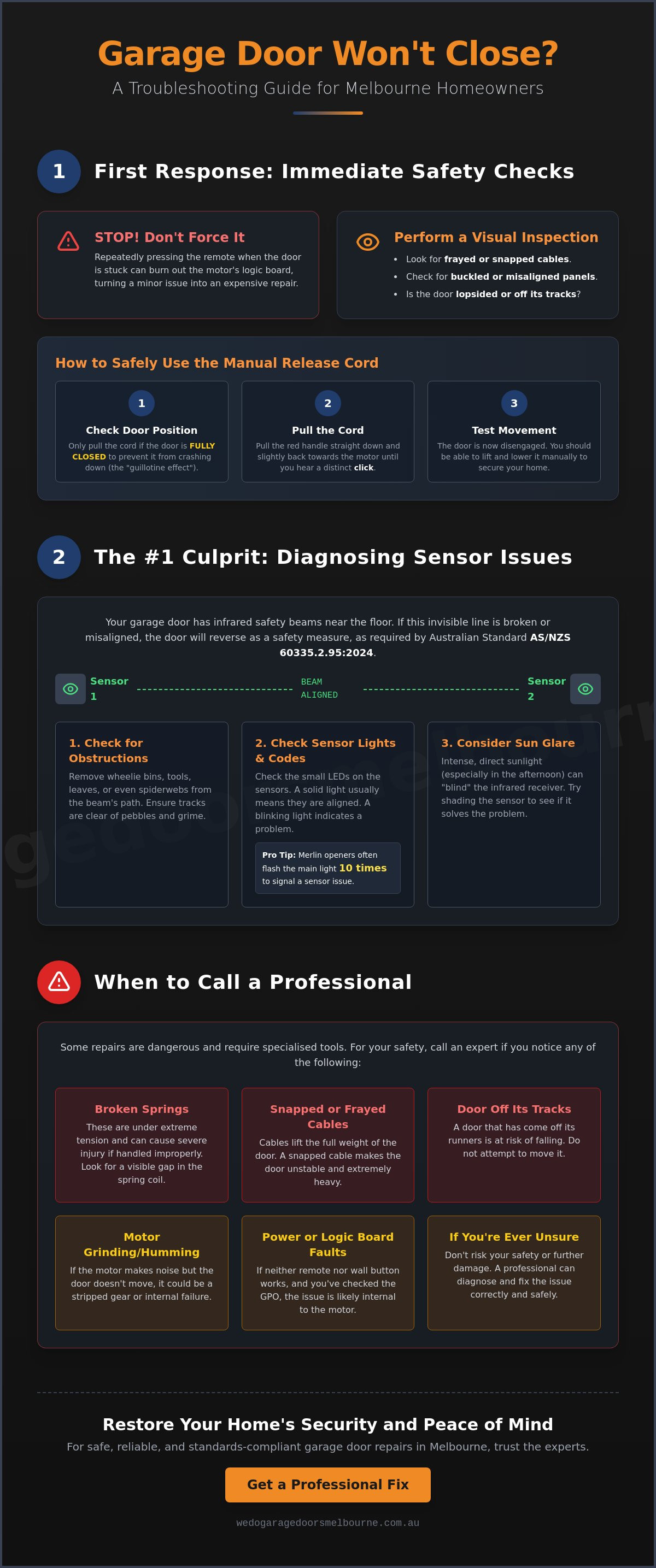
Finding your garage door stuck is a stressful experience, especially when the evening chill sets in and you are worried about the security of your home. It is tempting to keep hitting the remote button in the hope that it will eventually engage, but this often does more harm than good. When your garage door won't close Melbourne homeowners should resist the urge to force the system. Your garage door opener is a precision instrument; repeatedly cycling the motor when there is a blockage can lead to the logic board burning out. This turns a simple adjustment into a more complex motor replacement that could have been avoided with a bit of patience.
Before you try to move the door again, perform a calm visual inspection of the entire system. Look for obvious signs of trouble like frayed cables, which may look like they are "unravelling," or panels that appear buckled or out of alignment. If the door looks physically damaged or lopsided, do not attempt to move it manually. However, if the door looks straight but simply won't respond to the remote, you can move on to checking for basic obstructions or using the manual override.
Using the Manual Release Cord Safely
The red cord hanging from your motor is a vital safety feature, but it must be handled with care to avoid injury. This cord allows you to disengage the motor from the carriage so you can move the door by hand. To use it safely, follow these steps:
Check the door position: Only pull the cord if the door is fully closed. If you pull it while the door is partially open and a spring is broken, the door could crash down with incredible force. This is known as the "guillotine effect" and can cause serious injury.
Pull the handle: Pull the red handle straight down and slightly back toward the motor until you hear a distinct click.
Test the movement: Once disengaged, you should be able to slide the door down manually to secure your home for the night.
Checking for Physical Obstructions
Melbourne's active lifestyle means our garages often double as storage hubs for wheelie bins, garden tools, and sporting gear. Often, the reason your garage door won't close Melbourne is simply a stray rake or a bin placed just a few centimetres too far forward. These items trigger the auto-reverse safety feature, which is a mandatory requirement for all automatic openers in Australia to prevent accidents.
Take a moment to inspect the floor tracks for small pebbles, sticks, or a build-up of leaf litter that might be blocking the path. You can perform a simple "pencil test" by placing a small object on the floor in the path of the door. If the door touches the object and immediately reverses, your safety systems are working correctly, but it confirms that even minor debris in the tracks can prevent a successful closure. Clear the area thoroughly and ensure the tracks are free from any grime or obstructions before attempting to reset the motor.
Beyond simple debris, the condition of the concrete under your door plays a role in its longevity. While we focus on local repairs, looking at the work of concrete driveway contractors sydney shows how a perfectly level and high-quality finish can reduce wear on your door's tracks and motor over time.
Diagnosing Sensor Issues: The #1 Reason Doors Reverse
When a garage door won't close Melbourne homeowners often find that the culprit isn't a broken motor, but a simple sensor misalignment. These sensors, often called "safety beams" or infrared "eyes," are located at the base of your door tracks. They are designed to project an invisible beam across the opening. If this beam is broken by a child, a pet, or even a stray leaf, the motor will automatically reverse the door to prevent a crush injury. This feature is a mandatory requirement under Australian safety standards, specifically AS/NZS 60335.2.95:2024, which ensures that all modern automatic openers protect your family and property.
You can usually tell if your sensors are the problem by looking at your motor unit. Popular Melbourne brands like Merlin use a "blinking light" code to communicate errors. If you notice the main light bulb flashing ten times or a small LED on the sensor itself flickering, it is a clear sign that the infrared path is obstructed or out of alignment. Sometimes, the harsh Victorian sun can actually "blind" these sensors. During a bright summer afternoon, the intense glare can overwhelm the infrared receiver, making the system think there is an obstruction. If your door only refuses to close during the sunniest part of the day, you might need to install a small sun shield or cardboard "hood" to shade the lens.
In addition to environmental factors like sun glare, curious pets frequently triggering safety sensors can be a common source of garage door reversals. To help manage your animal's behaviour and ensure they stay safe around the home, Pro-Dog K9 Academy offers professional at-home obedience training tailored to their natural environment.
Realignment Techniques for Homeowners
Safety Beam Alignment is the process of ensuring the infrared path between the sending and receiving sensors is completely unbroken. If your brackets have been bumped by a wheelie bin or a lawnmower, the sensors will no longer be "talking" to each other. You can fix this by loosening the wing nuts on the sensor brackets and gently pivoting the units until the indicator lights glow a steady, solid colour. No specialised tools are required for this adjustment; a steady hand and a bit of patience are usually enough to restore the connection. If the lights continue to flicker regardless of how you move them, it might be time to book a professional customer service call to check for wiring faults.
Pest and Dust Management
Melbourne's environment presents unique challenges for delicate electronics. After a particularly windy arvo, dust from the northern suburbs or garden debris can coat the sensor lenses, scattering the infrared signal. Even more common are our local spiders. "Cobbies" and thick webs spun directly over the lens are a leading cause of mystery reversals. To clean them safely, use a soft, dry microfibre cloth to gently wipe the plastic lenses. Avoid using harsh chemical cleaners or abrasive sponges that could scratch the surface, as even a small scratch can permanently distort the beam. Keeping the area around your sensors clear of cobwebs and leaf litter is one of the simplest ways to ensure your garage stays secure.
Mechanical Malfunctions: Tracks, Cables, and Springs
If you have checked the sensors and the path is clear, yet your garage door won't close Melbourne homes frequently suffer from mechanical fatigue caused by our shifting temperatures. A garage door is a heavy piece of moving equipment that relies on a precise balance of tension and alignment. When this balance is disrupted, the motor will often stop as a safety precaution. You might notice the door sitting lopsided or hear a sudden, loud bang from the garage; this is the tell-tale sound of a spring snapping under pressure. Unlike the simple sensor fixes we discussed earlier, mechanical malfunctions often require a more technical eye to identify before they cause permanent damage to your motor.
Listen closely to the sounds your door makes during operation. A high-pitched squeal often points to rollers that are "grabbing" the track, while a heavy grinding noise suggests the motor is struggling against a lack of tension. If the door feels unusually heavy when you try to lift it manually, your springs have likely reached the end of their lifespan. While garage door safety sensors protect against obstructions, they cannot compensate for a door that is physically unable to move smoothly due to worn hardware; in such cases, sourcing quality parts from an online specialist like Door-Tech Services can be a helpful way to identify the right replacement components for your system.
In addition to garage door components, for those looking to repair other home systems, you can check out Hvidevaredele.dk to find a wide selection of replacement parts for all types of white goods and household appliances.
Inspecting Your Tracks and Rollers
The tracks act as the railway for your door, and any misalignment here will cause a jam. Check the vertical and horizontal rails for loose bolts or brackets that might have vibrated free over time. A common mistake is applying thick grease to the inside of the tracks. This actually attracts grit and grime, creating a sticky paste that hinders movement. Instead, keep the tracks clean with a damp cloth and only lubricate the rollers and hinges. If you see a roller that has popped out of the track, don't try to hammer it back in. This can buckle the rail and lead to a much more expensive repair than a simple realignment.
The Danger Zone: Springs and Cables
This is where DIY troubleshooting must stop for your own safety. The springs on your door are under immense tension, holding enough energy to cause severe injury if they snap during a repair. A clear visual sign of a problem is a visible gap in the coils of a torsion spring, or a cable that has "bird-nested" and come off its drum. Because of these risks, garage door spring replacement Melbourne is strictly a job for a qualified technician. A broken cable or spring will cause the door to hang at a dangerous angle, making it impossible to close securely without professional intervention and specialised tools.
Motor and Electronic Glitches: Beyond the Remote
Sometimes the hardware is in perfect condition, but the digital "handshake" between your remote and the motor has failed. When your garage door won't close Melbourne residents should first determine if the issue is with the radio signal or the motor unit itself. A simple way to isolate this is by using the internal wall button. If the door closes perfectly when you press the hardwired button but ignores your remote, you are likely dealing with signal interference or a flat battery. This is a common relief for homeowners, as it proves the expensive mechanical parts are still functioning correctly.
Frequency interference is a growing problem in Melbourne's densifying suburbs. Modern LED light bulbs, particularly cheaper imports, can actually emit electromagnetic noise that jams the 433MHz frequency used by many older openers. If you have recently installed new lighting in your garage or driveway, try turning them off and testing the remote again. Similarly, a neighbour's new security system or a stuck button on another remote in the house can "flood" the receiver, preventing your signal from getting through. Before assuming the worst, check your power supply at the GPO (general purpose outlet) to ensure a circuit hasn't tripped during a Melbourne storm.
Troubleshooting the Remote and Opener
Start with the basics: the 30-second battery test. Even if the little red light on your remote still flickers, it might not have enough "juice" to send a strong, clear signal. If a fresh battery doesn't work, try a "hard reset" by unplugging the motor from the GPO for one full minute. This clears the logic board's temporary memory and can often resolve minor glitches. However, if you hear a faint humming or smell a distinct "electrical" scent without any movement, you might be looking at a garage door motor replacement Melbourne due to a burnt-out capacitor or a failed logic board.
Smart Control and WiFi Issues
For those using a smart garage door opener Melbourne, app glitches can be particularly confusing. You might receive a notification saying your door is "Open" when it is clearly shut, or the app might fail to trigger the motor entirely. This is often down to WiFi signal strength; the brick and concrete used in many local homes act as a shield against your router. If your smart door control is acting up, check if your home network reaches the garage consistently. A simple WiFi extender can often restore the reliability you need for peace of mind. If your motor continues to behave erratically despite these resets, it is time to book a professional motor assessment to ensure your home remains secure.
When to Call a Melbourne Professional: Security and Safety
While the troubleshooting steps we have covered can resolve many minor glitches, there are times when your garage door won't close Melbourne homes need the expertise of a professional. If you have reached this stage and the door remains stuck, your primary concern is likely home security. An open garage is an invitation for trouble, and we believe no one should have to sleep with one eye open. For those interested in how security professionals operate globally, Leicestershire Locksmiths Limited provides a great example of the 24/7 emergency support required to keep a property safe. Choosing a reliable garage door technician Melbourne ensures your home is secure for the night and that the root cause of the failure is addressed with precision.
Certain repairs require specialised tools that most homeowners simply do not have in their shed. Adjusting high-tension springs requires winding bars, and verifying the balance of a heavy sectional door requires professional tension gauges. Attempting to use makeshift tools like screwdrivers or pliers is incredibly dangerous and can lead to severe injury. A master of the craft brings both the right equipment and technical mastery to restore your door's function without risking further property damage. For instance, the high standards maintained by Liberty Door Repair show how professional expertise ensures both residential and commercial doors operate safely and reliably. Our "Secure for the Night" approach prioritises your safety, ensuring that even if a part needs ordering, your home is left in a safe and locked state.
Why DIY Can Cost More in the Long Run
It is easy to accidentally cause more harm than good when tinkering with motor settings. If you attempt to reset the travel limits incorrectly, you might force the motor to keep pushing against the floor, which can lead to a burnt-out logic board. This turns a simple service call into an expensive motor replacement. Most major brands also have strict warranty terms; self-repair on high-value components can often void your coverage. The best way to avoid these headaches is through an annual garage door service Melbourne, which identifies wear and tear before it results in a midnight emergency.
While regular maintenance protects your home's entry points, many property owners also take the opportunity to modernise their interiors; for those looking to upgrade, you can explore Bathroom Renovations to see how professional design can transform your space.
Local Support in Melbourne’s Northern Suburbs
We take great pride in being a part of the local community, offering prompt assistance for garage door repair Greenvale VIC and surrounding suburbs like Craigieburn. When you book a professional service call, you can expect a thorough inspection of all moving parts, a comprehensive safety test of the auto-reverse mechanism, and professional lubrication of the tracks and rollers. Our goal is to move you from a state of frustration to one of total ease. Get your garage door moving again with We Do Garage Doors and enjoy the peace of mind that comes with a job done right.
Restoring Your Home's Security and Peace of Mind
Dealing with a garage door that refuses to budge is a stressful disruption to your daily routine, but you now have the knowledge to identify whether the fix is a simple sensor realignment or a complex mechanical failure. From clearing Melbourne dust off your safety beams to resetting your motor's logic board, most issues can be narrowed down through a patient process of elimination. When your garage door won't close Melbourne homeowners can take comfort in knowing that a safe and secure home is only a few steps away.
While you wait for your home to be secured, taking a moment to relax can help manage the stress of the situation; for those who appreciate quality craftsmanship, you can visit The Roast Haus Coffee Co. to explore their selection of artisan, roasted-to-order beans.
If troubleshooting hasn't solved the mystery, don't risk your family's security by leaving the garage open overnight. Our master technicians bring over 8 years of dedicated experience to every service, specialising in the technical mastery of Merlin and B&D systems throughout Greenvale, Craigieburn, and the Northern Suburbs. We are ready to provide the professional care and precision your home requires. Book an Emergency Garage Door Repair in Melbourne Now and let us restore the effortless convenience you deserve. We look forward to getting your door back in perfect working order.
Frequently Asked Questions
Why does my garage door start to close and then go back up?
This behaviour is typically triggered by the auto-reverse safety feature sensing an obstruction. All automatic openers in Australia must have this function to prevent the door from closing on a person or vehicle. It can be caused by something as small as a stray garden tool or a build-up of leaf litter in the tracks. If the path is clear, the motor might be sensing too much resistance due to worn rollers or a lack of lubrication.
Can I manually close my garage door if the motor is broken?
Yes, you can manually operate the door by pulling the red manual release cord to disengage the motor. This allows the door to slide freely along the tracks so you can secure your home. However, you should only do this if the door is fully closed or if you are certain the springs are intact. If a spring is broken, the door could crash down without the motor's resistance, which is a significant safety risk.
Why is the light on my garage door motor blinking?
A blinking light on your motor unit is a diagnostic code used to signal a specific internal fault. On popular brands like Merlin, ten flashes often indicate that the safety sensors are blocked or misaligned. This is a common reason why a garage door won't close Melbourne homeowners often see this after a storm or if a sensor has been bumped. Checking the specific flash pattern in your manual helps narrow down the electronic glitch quickly.
How do I know if my garage door sensors are misaligned?
You can identify misalignment by checking the small LED indicator lights on the sensors at the base of your door. Both the sending and receiving units should show a solid, steady light. If one light is flickering or completely dark, the infrared beam is broken. This often happens if the brackets have been knocked by a wheelie bin or if a spider has spun a thick web over the delicate plastic lens.
Is it safe to replace a garage door spring myself?
No, you should never attempt to replace a garage door spring yourself as it is incredibly dangerous. These components are under extreme mechanical tension and can cause severe injury or even death if they snap during a DIY repair. Professional technicians use specialised winding bars and safety equipment to manage this tension. It is always better to call an expert for any spring or cable issues to ensure your safety.
What should I do if my garage door remote isn’t working but the wall button is?
The first step is to replace the batteries in your remote, as a weak signal is the most common culprit. If a fresh battery doesn't solve the problem, you might be facing radio frequency interference from new LED lights or a neighbour's security system. Since the wall button still works, you know the motor and logic board are functioning. You may simply need to re-sync the remote to the motor's receiver.
How often should I have my garage door serviced in Melbourne?
We recommend a professional service every 12 months to ensure your system remains reliable and safe. Melbourne's unpredictable weather and temperature shifts can accelerate the wear and tear on springs, rollers, and cables. Regular maintenance can extend the lifespan of your door from 15 years to over 25 years. A yearly check also ensures your auto-reverse functions and safety beams continue to meet the latest Australian safety standards for your peace of mind.
Who provides emergency garage door repairs in Craigieburn and Mickleham?
We Do Garage Doors offers prompt emergency repairs and customer service calls throughout Craigieburn, Mickleham, and the northern suburbs. Our local technicians are experts in Merlin and B&D systems, providing fast solutions when your garage door won't close Melbourne. Whether you need a motor replacement or an urgent spring repair, we are committed to making your home secure. We take pride in our high standard of craftsmanship and our deep connection to the local community.


Comments