

How Long Do Garage Door Springs Last? A Melbourne Homeowner’s Guide
Updated: Jun 20
Imagine you're already five minutes late for the morning school run, you press the remote button, and instead of a smooth lift, you're met with a deafening bang that leaves your car trapped inside. It's a frustrating and genuinely stressful situation that many Melbourne homeowners fear, especially when you realise that a heavy door weighing over 100kg is now a dangerous dead weight. While it is easy to overlook them, knowing exactly how long do garage door springs last is essential for any homeowner who values daily reliability and peace of mind.
You likely don't give your garage door springs much thought until they fail, yet these hard working components are the literal muscles of your home's largest entrance. Most springs in Australian conditions are designed to last between seven and twelve years, but factors like our local weather and your specific usage frequency can quickly change that timeline. This guide will help you discover the true lifespan of your hardware and teach you how to spot critical warning signs before a snap occurs. We will also look at the difference between torsion and extension springs so you can feel confident knowing when it is time to call in a professional technician for a service.
Key Takeaways
Learn why the industry standard of 10,000 cycles determines how long do garage door springs last and how this translates into years of daily use for your home.
Understand the mechanical differences between torsion and extension springs to identify which system is currently supporting your garage door.
Discover how Melbourne’s unique climate, from sudden temperature drops to coastal humidity, can impact the durability of your door's steel components.
Identify the six most common warning signs of spring fatigue so you can organise a replacement before a total failure occurs.
Recognise the safety risks associated with high tension springs and why professional tools are vital for a secure and lasting repair.
Table of Contents
Understanding Garage Door Spring Lifespan: Cycles vs. Years
To truly understand how long do garage door springs last, we need to look past the calendar and focus on the mechanics of movement. While most homeowners think in terms of years, manufacturers and technicians measure life in "cycles." A cycle is the fundamental unit of garage door longevity; it represents one full opening and closing of the door. Because most residential doors rely on a spring-loaded or counterbalanced mechanism to do the heavy lifting, each movement creates a specific amount of fatigue in the steel coils. Eventually, that steel reaches its limit and snaps.
The 10,000 Cycle Standard Explained
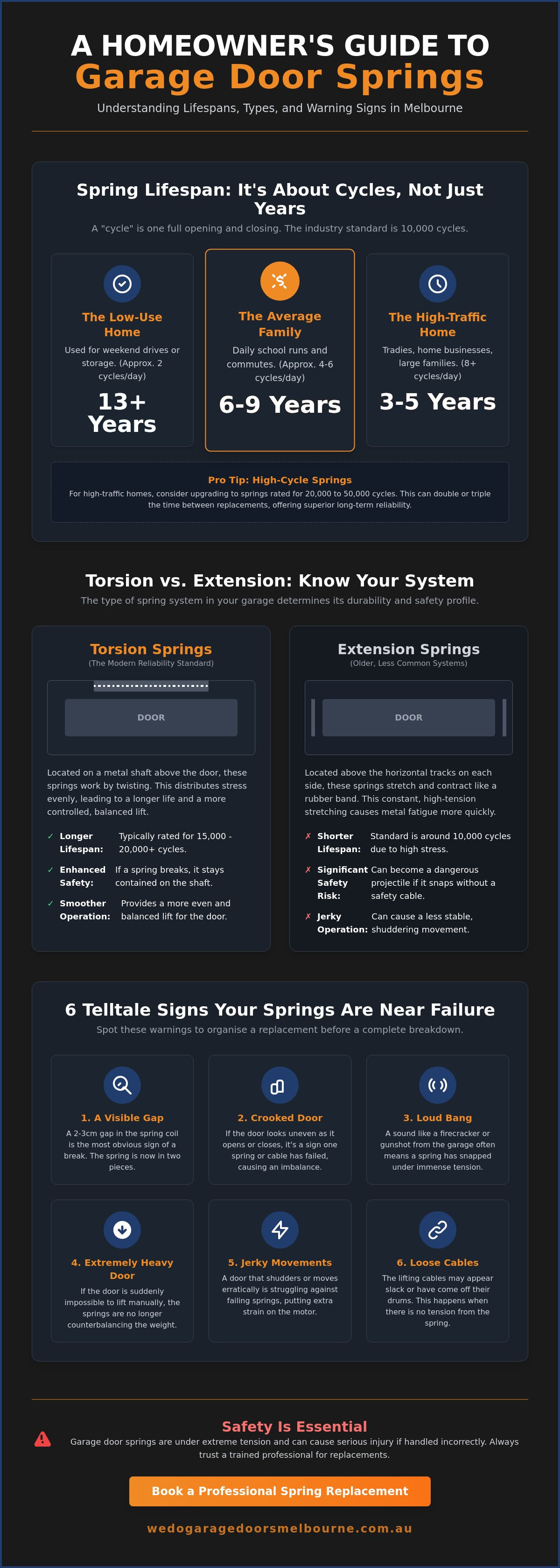
The industry standard for a new residential spring is typically 10,000 cycles. If you only use your garage door twice a day, your springs could theoretically last for over 13 years. However, this math rarely aligns with the reality of a modern Melbourne household. For a busy family using the door four times a day for school runs and commutes, that lifespan drops to roughly six or seven years. It's helpful to remember that the "years" estimate you might hear is only a rough generalisation. It's the frequency of use that dictates the actual countdown to a failure.
Why "Years" Can Be Deceiving for Melbourne Families
In Melbourne's northern suburbs, many households operate with much higher demands than the "standard" model. If you're a tradie heading out early, coming home for a quick lunch, and then returning again in the evening, your cycle count is already climbing faster than average. Multi-car households or families who use the garage as the primary entrance to the home put their hardware under immense pressure every single day. When you're trying to figure out how long do garage door springs last in your specific home, consider these common usage patterns:
The Low-Use Home: Doors used only for weekend drives or storage (can last 15+ years).
The Average Family: Daily school runs and standard commuting (typically 6-9 years).
The High-Traffic Home: Tradies, home businesses, or large families (often 3-5 years).
For those who know their door is constantly on the move, high-cycle springs are a smart investment. These are engineered for 20,000 or even 50,000 cycles. While they look similar to standard springs, the wire gauge and tempering are specifically designed for durability. This upgrade effectively doubles or triples the time between replacements, providing long-term reliability for homes that never seem to stop.
This focus on durability and specialised components is mirrored in other high-tension mechanical systems, such as automotive engineering; for instance, Car Suspension Repair provides expert services for vehicles that rely on high-performance spring and shock systems to manage daily wear and tear.
Torsion vs. Extension Springs: Which Lasts Longer?
Not all springs are created equal. When you look at your garage door, where the springs are located tells you a lot about their durability. Torsion springs sit horizontally on a steel shaft directly above the door opening, while extension springs run along the upper tracks on either side. This difference in placement dictates the physical stress the metal undergoes and ultimately determines how long do garage door springs last in your specific setup.
Torsion Springs: The Modern Reliability Standard
These are the premium choice for modern builds across Melbourne, particularly in newer estates like Craigieburn and Mickleham. Torsion springs work through torque; they twist and unwind to manage the door's weight. This twisting motion distributes the load more evenly across the entire length of the spring, which reduces localised fatigue. High-quality torsion versions are often rated for 15,000 to 20,000 cycles, providing a significant lifespan advantage over older alternatives. Because they are contained on a shaft, they also tend to stay put if they break, offering a much higher level of safety for your family and vehicles.
When searching for a home in these rapidly developing suburbs, Your Australian Property Buyers Agents can provide the professional guidance needed to find a property with high-quality features and lasting value.
Extension Springs: Why They Are Fading Out
You will typically find extension springs on older tilt doors or smaller sectional doors. These operate by stretching and contracting, much like a giant heavy-duty rubber band. Every time the door closes, the spring is pulled to its absolute limit. This constant stretching causes the metal to fatigue much faster than the twisting motion of a torsion system. Without a safety cable running through the centre, a snapping extension spring can become a dangerous projectile. While these systems were once common, modern safety expectations have evolved. Many homeowners now choose to upgrade their hardware during a professional spring replacement to ensure their setup meets current reliability standards.
Safety is a primary concern for any moving part under such extreme tension. While Australia has its own rigorous standards, it is helpful to look at international benchmarks like the mandatory federal consumer product safety standard which emphasises the importance of secondary safety features in automatic systems. If your current springs are over a decade old or showing signs of rust, the mechanical difference between torsion and extension becomes more than just a technicality; it becomes a question of home security. Understanding these differences helps you make an informed decision when evaluating how long do garage door springs last before needing an upgrade.
Factors That Shorten Spring Life in Melbourne’s Northern Suburbs
Melbourne's climate is notoriously unpredictable, often swinging through four seasons in a single afternoon. While we previously discussed usage cycles, these local environmental factors play a massive role in determining how long do garage door springs last. Rapid temperature fluctuations, which are common in the northern suburbs, cause the steel in your springs to expand and contract. This constant thermal stress makes the metal more brittle over time. If your garage is uninsulated, these temperature swings are even more pronounced, directly impacting the structural integrity of your hardware.
Environmental Wear: Humidity and Corrosion
Moisture is a silent killer for garage door components. In suburbs like Greenvale, where damp valleys can trap humidity, or in areas closer to the bay where salt air is a factor, oxidisation becomes a serious concern. Surface rust is not just an aesthetic issue; it acts as a destructive abrasive. As the spring coils rub against each other during a cycle, the rust creates friction that eats away at the steel. This friction often leads to microscopic cracks that eventually result in a sudden, violent snap.
To combat this, we always recommend using a high-quality "wet" silicone-based lubricant rather than generic grease or WD-40. Proper lubrication creates a protective barrier against the elements, helping the metal move without internal resistance. Technical standards for these components are often defined by industry organizations like DASMA, which highlight how environmental protection is key to reaching the rated cycle life of any spring system.
The Heavy Door Syndrome
Another major factor is the weight of the door itself. Many Melbourne homes feature beautiful timber doors that, while stylish, can become significantly heavier if they absorb moisture during a wet winter. Similarly, double-layer insulated steel doors add extra bulk that your springs must manage. If the springs installed are not perfectly matched to the door's actual weight, they are essentially being punished every time they move. This imbalance is a primary reason why some homeowners see their springs fail years earlier than expected.
A spring rated for a standard light door will fail much sooner if it is forced to lift a heavy, water-soaked timber alternative. This is why expert garage door repairs in Melbourne always include a comprehensive balance check. A balanced door should feel light enough to lift halfway by hand; if it feels like a struggle, your springs are overworking and their lifespan is shrinking. Keeping an eye on these local variables ensures you aren't caught off guard by a broken spring well before its time.
For garage door business owners who want to grow their presence and reach more homeowners, Door & Gate Domination offers specialised digital marketing and SEO strategies; you can find out more about how they help contractors scale their operations.
6 Telltale Signs Your Garage Door Springs are Near Failure
While we can use cycle counts to estimate how long do garage door springs last, your hardware will often provide physical warnings before it gives up completely. The most dramatic sign is the "Loud Bang." If you are ever at home and hear a sound like a gunshot or a heavy sledgehammer hitting concrete coming from your garage, that's almost certainly a spring snapping. It is a violent release of energy that can be quite a shock; it usually means the door is now a stationary 100kg weight that your motor should not try to move. Don't ignore this sound even if the door looks normal, as the tension is now gone.
Visual Cues and Physical Gaps
A quick visual inspection can save you from the frustration of being trapped in your driveway on a busy Monday morning. For those with a torsion system, look at the metal shaft above the door. If you see a clear gap of about two inches in the middle of the coil, the spring is broken. A visible gap in a torsion spring means it has already failed and is no longer providing any lift. For extension springs running along the upper tracks, look for coils that appear distorted or "stretched" out. These gaps show the steel has lost its elasticity and is on the verge of a total break.
Operational Warning Signs
Your door's movement tells a story about the health of its internal components. If you notice the door "stuttering" or making jerky movements as it travels, the springs are likely failing to provide an even counterbalance. Many homeowners assume a straining motor needs replacing, but it's often just the motor working overtime to lift a door that the springs are no longer helping with. You might also hear a persistent squeal or groan. While some noises are just a lack of oil, a deep mechanical groan often suggests the internal structure of the spring is failing under the load.
You can test the health of your hardware yourself with the "2-Metre Test." Carefully disconnect your automatic opener and lift the door halfway by hand, about two metres high. If the springs are healthy, the door should stay balanced in that position without much effort. If it crashes down or feels impossible to lift, your springs are exhausted and pose a major risk to your safety. If your door fails this simple check, it is time to organise a professional spring replacement before the situation becomes an emergency.
Safe Replacement: Why Professional Servicing is Essential
Understanding how long do garage door springs last helps you stay ahead of maintenance, but the moment a spring fails, safety must become your first priority. These steel coils are not simple hardware; they are high-tension components storing hundreds of kilograms of force. Because the tension is at its peak when the door is closed, any slip during a DIY attempt can result in the door crashing down or the spring releasing its energy violently. This level of risk often leads to serious injuries, such as broken bones or deep lacerations, which is why specialised winding bars and professional expertise are non-negotiable. A professional technician understands the exact number of turns required to balance the door perfectly, a task that is nearly impossible without the right equipment.
For readers interested in how specialised technicians handle these high-tension systems, you can learn more about Liberty Door Repair and their approach to safe residential and commercial door maintenance.
Rather than risking a dangerous mishap, opting for an emergency garage door repair in Melbourne provides a secure, efficient solution. Our technicians approach every job with a focus on technical mastery and local hospitality, ensuring your home remains a safe and functional environment for your family. We take pride in the precision of our work, moving you from a state of frustration to one of complete security in a single visit.
Why We Replace Both Springs Simultaneously
When we visit a home to fix a snapped spring, we usually find that both components were installed at the same time. Since they have both completed the same number of cycles, the surviving spring is almost certainly fatigued to the same degree as the one that broke. This leads to the "Second Snap" phenomenon, where the remaining spring fails only days or weeks after the first repair. It is a frustrating cycle that can be easily avoided by addressing both sides of the door at once.
Replacing both springs simultaneously is the most logical way to ensure a perfectly balanced door. This balance is vital because it protects your automatic motor from overworking, ultimately saving you from more expensive motor replacements down the track. When the springs are properly matched, the door should glide effortlessly along the tracks, placing minimal stress on the internal gears of your opener. It is a simple, proactive step that guarantees long-term reliability and the effortless operation you expect from your home's largest moving part. By the time we finish, you'll have a door that is as quiet and reliable as the day it was first installed.
Maintaining high-performance mechanical systems—whether it’s your garage door or your vehicle—requires a commitment to quality and expertise. For those who want to ensure their car receives the same level of specialised care, you can learn more about Eurotech Automotive and their dedicated services for European vehicles.
Restore Peace of Mind to Your Daily Routine
Your garage door is more than just a convenience; it's a vital part of your home's security and daily rhythm. As we have explored, the true answer to how long do garage door springs last depends on your family's daily cycles and the unique environmental pressures of Melbourne's northern suburbs. By keeping an eye out for visible gaps or operational groans, you can address minor fatigue before it turns into a stressful morning emergency. Remembering that professional intervention is about protecting your safety and your motor will ensure your hardware remains in peak condition for years to come.
In the same way that a functional garage door ensures a smooth start to your day, having your personal technology in working order is vital for staying connected; for those commuting into the city, SIMSIM Repairs offers professional mobile and computer services in the heart of Melbourne.
Just as you maintain your garage door for daily reliability, keeping your indoor appliances in top shape is equally important for a smooth-running home; you can visit Hvidevaredele.dk to find the specific spare parts, such as fridge drawers or shelving, needed to extend the life of your household white goods.
If you've noticed your door straining or if it has been nearly a decade since your last service, our team is here to help. We provide same-day service across the northern suburbs and use high-cycle replacement parts as standard to give you the longest possible lifespan. Our fully insured and qualified technicians take the guesswork out of maintenance, providing the technical mastery your home deserves. Get your garage door springs checked by a Melbourne master technician today and enjoy the effortless reliability of a perfectly balanced door. We look forward to helping you keep your home running smoothly.
Frequently Asked Questions
Can I still use my garage door if one spring is broken?
No, you should never attempt to operate your garage door once a spring has snapped. While your automatic opener might still try to lift the door, it is now pulling an unbalanced weight that can exceed 100kg. This puts extreme pressure on the motor and cables, often leading to much more expensive repairs or the door crashing down unexpectedly. It's best to leave the door closed and disconnect the motor until a technician arrives to secure the system.
How much does it cost to replace garage door springs in Melbourne?
The investment for a professional spring replacement varies based on the size and weight of your door, as well as the specific type of springs required. Factors like the wire gauge and whether you choose standard or high-cycle parts will influence the total. Because every home has different requirements, we focus on providing a tailored solution that ensures your door is perfectly balanced and safe for your family's daily use.
Is it possible to just repair a spring instead of replacing it?
No, it is technically impossible to repair a snapped or fatigued garage door spring. These components are made from high-tension steel that is tempered to hold a specific amount of energy. Once the metal has failed or lost its elasticity, any attempt to weld or "patch" it would be incredibly dangerous and would fail under the first cycle of tension. For your safety, the only reliable option is to replace the exhausted hardware with fresh, correctly rated springs.
If you are based in the Phoenix Valley and require expert assistance with your system, you can visit Swiftly Garage Doors to discover more about their professional spring replacement and repair services.
What is the "gunshot" sound I heard in my garage last night?
That loud, sharp bang was almost certainly the sound of your torsion or extension spring snapping. Because these springs are wound under intense pressure, the metal releases a massive amount of energy the moment it breaks. This sound is a definitive warning that your door's counterbalance system has failed. If you hear this noise, avoid pressing your remote button and check the springs above or beside your door for a visible gap in the coils.
How do I know if I have torsion or extension springs?
You can identify your system by looking at the placement of the springs relative to the door. Torsion springs are mounted horizontally on a metal shaft directly above the door opening. Extension springs are typically found on older tilt doors and run along the upper horizontal tracks on each side. Knowing your spring type helps when you're trying to estimate how long do garage door springs last, as torsion systems generally offer a longer and more reliable lifespan.
How often should I lubricate my garage door springs to make them last?
We recommend a quick lubrication every six months to help maximise how long do garage door springs last in our local climate. Use a high-quality silicone-based lubricant rather than generic grease or WD-40, as these can attract dust and grime that actually increases friction. A light coating during the change of seasons helps prevent surface rust and ensures the coils move smoothly against each other without creating microscopic cracks in the steel.
To keep your maintenance schedule on track, consider using a clear labelling system to mark the date of your last service; for high-quality tools that help keep your home and garage organised, visit dymoonline.com.au.
Will my garage door motor burn out if my springs are weak?
Yes, weak or unbalanced springs are one of the primary reasons garage door motors fail prematurely. Your motor is designed to act as a guide, not a heavy lifter; the springs are supposed to do the hard work of counterbalancing the door's weight. When springs lose their tension, the motor has to strain significantly harder to open the door. This constant overworking leads to stripped gears and burnt-out circuit boards, often resulting in a much larger bill than a simple spring service.
Can I replace my own garage door springs safely?
No, DIY spring replacement is a high-risk activity that we strongly advise against for any homeowner. The specialised tools and precise winding techniques required are essential for managing the hundreds of kilograms of force stored in the springs. A single slip with a winding bar can lead to facial injuries, broken fingers, or a falling door. Entrusting the job to a qualified professional ensures the work is done safely and that your door is perfectly balanced for long-term reliability.


Comments