

Garage Door Opener Battery Replacement: Melbourne Guide
Picture this: it’s 7:30 am on a brisk Melbourne morning, you are already running behind, and an unresponsive door leaves your car trapped inside. When your automated setup suddenly refuses to lift, a quick garage door opener battery replacement is often all that stands between total chaos and getting on with your day. It is easy to fear the entire motor has burnt out, but opener failure usually stems from one depleted battery rather than a complete mechanical breakdown.
We know how unsettling mystery beeps from the ceiling can be, just as we understand the worry of snapping delicate plastic casing or wiping your remote's memory codes. In this guide, you will learn how to identify whether your handheld remote or motor backup battery is flat, replace it safely under Australian child-safety standards, and preserve your stored transmitter settings. We will also examine the clear signs that tell you whether an unresponsive door is suffering from worn mechanical springs rather than a simple power issue, restoring effortless operation to your home.
Table of Contents
Signs Your Garage Door Opener Battery Needs Immediate Replacement
Few things disrupt your routine quite like pressing your visor remote and having nothing happen. Before you assume the opener motor has burned out, pay close attention to how the system behaves. Most garage doors drop clear hints that an automated component is running out of juice long before complete failure strands your car inside.
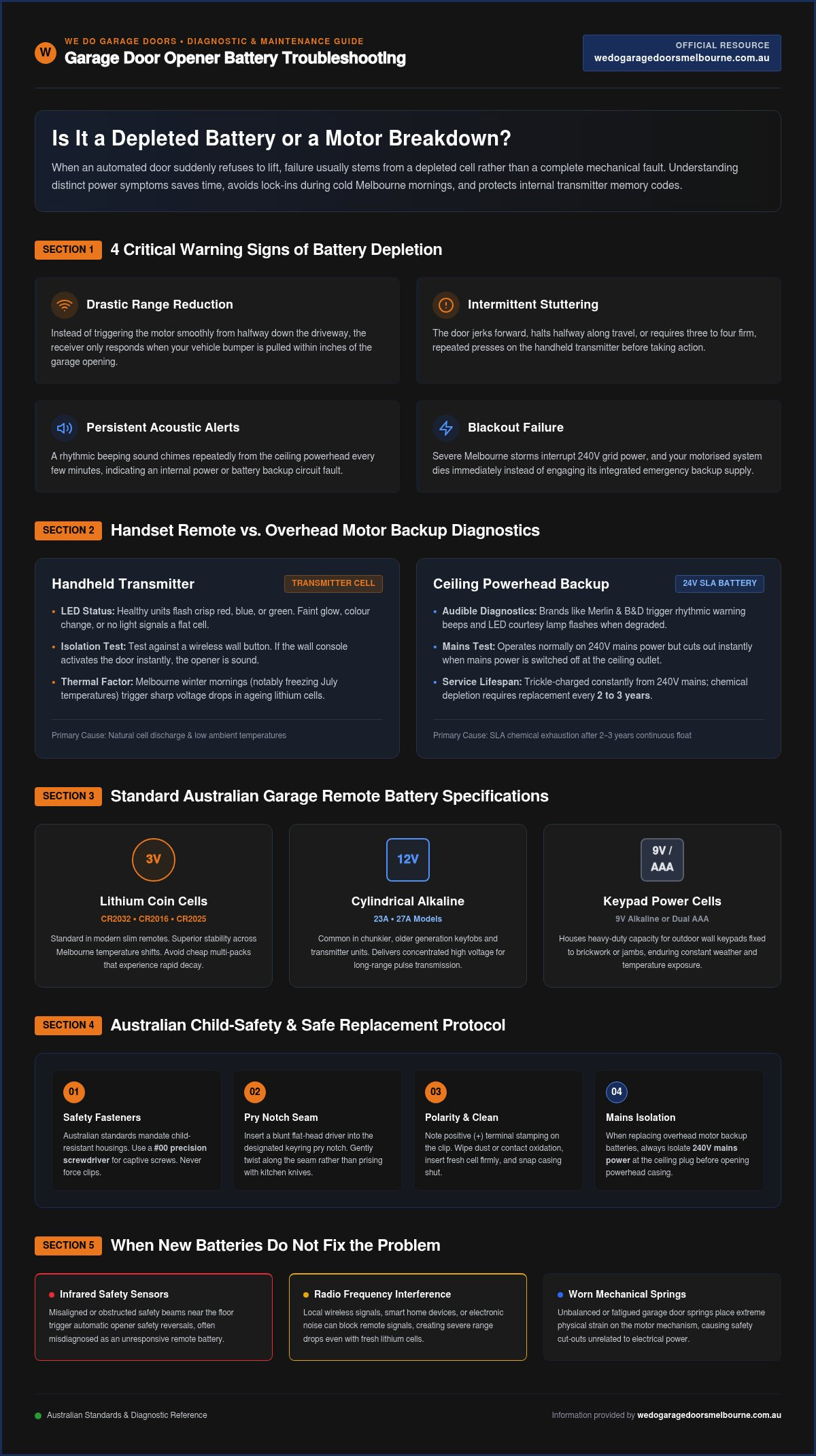
If you notice any of the following warning flags, it is time to arrange a garage door opener battery replacement:
Drastic range reduction: You used to open the garage from halfway down the driveway, but now you must pull your bumper within inches of the door before the receiver responds.
Intermittent stuttering: The door jerks forward, halts halfway, or demands three or four firm presses on the handheld transmitter before taking action.
Persistent acoustic alerts: A rhythmic beeping sound chimes from the ceiling powerhead every few minutes, signalling an internal electrical fault.
Blackout blackout: Severe Melbourne storms cut suburban grid power, and your motorised system instantly goes dead instead of switching to its integrated emergency power supply.
Handset Remote and Wall Button Warning Signs
Check the tiny indicator light on your transmitter first. A healthy remote displays a crisp, bright red, blue, or green flash whenever you tap the button. If that light glows faintly, changes colour, or fails to illuminate at all, the internal coin cell is depleted. Test your spare handset or wireless wall button to verify. If the wall console triggers the door instantly but your pocket remote struggles, the door mechanism itself is fine. Keep in mind that chilly Melbourne winter mornings cause sudden voltage drops in older lithium batteries, often exposing a dying cell on the first freezing commute of July.
Overhead Motor Backup Battery Alert Signals
Ceiling-mounted drive units from brands like Merlin and B&D feature smart diagnostic monitoring. When their internal 24V Sealed Lead Acid (SLA) backup begins failing, the powerhead sounds a distinct sequence of warning beeps and flashes its LED courtesy lamp. These standby cells continually trickle-charge from 240V mains power, but chemical degradation naturally exhausts them after two to three years. If your opener functions perfectly while plugged into the wall socket but shuts down the second you switch off mains power at the ceiling point, you need a prompt garage door opener battery replacement for the backup module.
How to Replace Handheld Garage Remote and Keypad Batteries
Swapping out a flat cell in your transmitter is straightforward once you know how to handle the protective housing. Modern Australian safety regulations mandate child-resistant casings, meaning brute force will only snap delicate plastic clips. Approaching your garage door opener battery replacement with the right tools ensures an easy swap without risking internal component damage.
Matching Common Australian Remote Battery Sizes
Openers across Victoria rely on a handful of standard power sources. Most slim remotes run on 3V lithium coin cells, typically CR2032, CR2016, or CR2025 models. Chunkier, older keyfobs often require miniature 12V cylindrical alkaline cells, specifically 23A or 27A types. Avoid cheap multi-pack batteries from discount bins. Unbranded cells suffer rapid voltage decay during Melbourne's unpredictable temperature swings, leaving you stranded within months. Premium lithium cells handle thermal shifts far better and maintain steady output.
Opening the Casing Without Snapping Plastic Clips
Australian child-safety standards require remote battery compartments to use captive screws or dual-action openings. Use a #00 precision screwdriver to loosen the rear screw, or find the small pry notch located near the keyring loop. Twist a blunt flat-head screwdriver gently inside the seam rather than prising the halves apart with a kitchen knife. Slide the depleted disc out, observe the positive (+) terminal orientation stamped on the clip, and wipe away any dust or contact oxidation. Seat the fresh cell firmly and snap the casing closed. If your transmitter circuit board shows signs of heavy corrosion or worn micro-switches, upgrading to genuine replacement remotes is often the smartest long-term fix.
Replacing Wireless Keypad Batteries Safely
External wireless keypads fixed to brickwork or door jambs face continuous exposure to the elements. Loosen the locking screw beneath the base, then slide the casing upwards off its wall mounting bracket. Keypads generally house a heavy-duty 9V alkaline battery or dual AAA cells resting behind a weather-sealed rubber gasket. Insert the fresh battery, ensure the protective gasket sits flush to block driving rain, and remount the keypad. Existing PIN codes remain stored in permanent transmitter memory, meaning your keypad will work right away without tedious reprogramming.
Replacing the Battery Backup Unit in Your Garage Door Motor
Severe Victorian storms frequently knock out suburban power grids, leaving properties without electrical supply for hours. During an emergency or bushfire evacuation, an operational overhead backup system can be a genuine lifesaver. Most modern drive units house a 12V or 24V Sealed Lead Acid (SLA) pack that delivers two to four full lift cycles during an outage. If your ceiling unit is beeping or failing to respond during blackouts, completing a garage door opener battery replacement on the motor itself will restore your peace of mind.
Mains Safety and Electrical Precautions
Safety comes first when working overhead. Always disconnect the 240V mains power plug from the ceiling outlet before loosening any casing screws or opening access hatches. Position a stable stepladder directly beneath the opener track so you can work comfortably without overreaching. Keep your hands clear of the primary printed circuit board. You only need to access the dedicated battery bay and its low-voltage wiring harness.
Installing Sealed Lead-Acid and Lithium Backup Packs
Once you lower the protective battery compartment panel, follow these steps to renew the power cells:
Disconnect the harness: Slide the slip-on spade terminals off the battery lugs. Always disconnect the negative (black) wire first, followed by the positive (red) lead.
Extract the old pack: Slide the heavy lead-acid or lithium cartridge out of its retaining bay. Check the housing for acid residue or terminal corrosion before inserting the replacement.
Connect the new unit: Slide the fresh pack into the enclosure. Reconnect the positive red lead first, followed by the negative black lead, ensuring both spade connectors click tightly into position to avoid false warning beeps.
Recycle responsibly: In Victoria, items containing batteries are banned from kerbside bins. Drop your old lead-acid unit at a designated B-cycle drop-off point or local transfer station for free recycling.
Testing the Backup System Under Simulated Blackout Conditions
Reattach the battery bay cover and plug the 240V mains lead back into the ceiling point. Allow the new pack to trickle-charge undisturbed for twenty-four hours to reach peak capacity. To test the system, turn off the ceiling power point. Press your wall control or transmitter button. The motor should engage at a steady, cautious speed, often sounding an audible alert tone to confirm it is running smoothly under dedicated battery power.
Troubleshooting: When New Batteries Don't Fix the Issue
You have installed a fresh coin cell or backup pack, yet your door remains stubbornly still. It is a common frustration across Melbourne homes. Before assuming your brand-new cells are duds, remember that a complete garage door opener battery replacement only solves chemical power loss. An unresponsive system often points to signal disruption, safety sensor lockouts, or mechanical resistance along the tracks.
Reprogramming Desynchronised Handsets and Wall Consoles
Sometimes a transmitter simply drops out of the receiver's memory during an extended period without power. Look for the brightly coloured 'Learn' or 'Code Set' button located on the rear or underside of your overhead drive unit. Press and release this button briefly until the indicator lamp blinks, then immediately press the target button on your remote twice. Never hold the opener's learn button down for more than five seconds, as doing so wipes all stored radio codes and unpairs every remote in your home.
Checking Track Obstructions and Misaligned Safety Sensors
Automated openers rely on optical safety beams mounted inches from the garage floor to protect pets and vehicles. Check these optical eyes if the motor clicks but refuses to pull the door downward:
Wipe the lenses: Garden dust, cobwebs, and dried winter moisture frequently cloud the optical glass.
Check indicator colours: Both sensor units should display a solid green or yellow light; a flashing red LED confirms beam misalignment.
Clear the travel channels: Inspect the vertical side tracks for built-up grit, dead leaves, or bent channel lips that cause the opener's safety reverse system to trip.
Verify trolley engagement: Check that the red manual emergency cord has not been nudged, which leaves the carriage detached from the motor chain or belt.
Assessing Spring Balance and Motor Gear Fatigue
Mechanical failure frequently masquerades as electrical weakness. Modern openers monitor the physical torque required to lift a curtain or sectional panel. If a counterbalance spring snaps or loses tension, the opener suddenly bears the entire dead weight of the steel door. It will hum, move two inches, and immediately shut down to protect its internal drive nylon gears. Pull your emergency release cord with the door closed and lift it manually. If the panel feels heavy, drops like a stone, or refuses to stay suspended at waist height, read our detailed guide on garage door spring replacement Melbourne for critical spring tension safety advice. High-tension steel springs store lethal force and should never be tightened without professional tools.
If you have worked through these checks and your opener still refuses to budge, get in touch with our local team to book a master technician diagnostic visit today.
When to Call a Professional Garage Door Technician in Melbourne
Sometimes the issue runs deeper than what a standard garage door opener battery replacement can resolve. When electrical components fail or heavy structural parts lose balance, continuing to cycle an automated door will quickly burn out drive gears and strip internal belts. Knowing when to step back and call in a local specialist saves both time and unnecessary hardware damage.
Internal Motor Board Failures vs Simple Battery Issues
Electrical faults within the powerhead display symptoms quite different from a drained coin cell. If you detect a faint burning smell, notice flickering diagnostic lamps on the motor housing, or hear a dull humming sound while the chain refuses to move, the internal logic board or starting capacitor has likely failed. In these scenarios, technicians evaluate whether targeted component repairs will suffice or if upgrading to a brand-new garage door motor replacement Melbourne offers greater long-term reliability. Modern units also let you install a smart garage door opener Melbourne, delivering live battery health monitoring and instant cycle notifications directly to your smartphone.
Preventative Maintenance and Door Balancing Across Melbourne Suburbs
Automated openers are designed to guide counterbalanced doors, not drag dead weight. Forcing an opener to pull an out-of-balance or sagging door puts enormous strain on the motor carriage, mimicking battery failure and rapidly exhausting fresh backup cells. Regular professional upkeep protects your automated hardware from premature wear and sudden breakdown:
Spring tension adjustment: Master technicians test overhead torsion and extension springs to ensure proper counterweight balance.
Track alignment and lubrication: Rollers, hinges, and steel bearing plates receive precision cleaning and food-grade lubricant to eliminate drag.
Comprehensive electrical testing: Diagnostic meters verify proper battery charging rates, radio frequencies, and auto-reverse safety sensitivities.
Booking an annual garage door service Melbourne preserves your system's longevity and keeps safety reserves operating seamlessly during unexpected blackouts. Across northern and western suburbs, including Craigieburn, Greenvale, Mickleham, Roxburgh Park, and Wollert, our technicians arrive equipped to carry out comprehensive safety checks on the spot. Whenever your garage door jerks, hesitates, or refuses to lift even after a battery swap, arrange expert garage door repairs Melbourne to restore dependable security to your property.
Keep Your Garage Door Operating Smoothly Year-Round
A flat remote or depleted backup unit does not have to disrupt your daily routine. Identifying the correct coin or alkaline cell, working carefully with child-resistant casing clips, and checking that heavy spring tension isn't straining the motor makes all the difference. Handled methodically, a straightforward garage door opener battery replacement quickly restores seamless convenience and keeps your automated entry prepared for unexpected storm outages.
If fresh cells fail to solve the fault or you would rather have experienced hands handle overhead wiring, our local team is ready to step in. As an independent Melbourne-owned business operated by master technicians since 2018, We Do Garage Doors provides prompt mobile service across Craigieburn, Greenvale, Mickleham, Roxburgh Park, and Wollert. Every visit includes a complete mechanical safety inspection alongside precise electrical diagnostics, ensuring your tracks, balance springs, and motor work together in flawless harmony. Book a friendly garage door diagnostic service with We Do Garage Doors and enjoy dependable, hassle-free security every time you pull into your driveway.
Frequently Asked Questions
How do I know what size battery my garage door remote takes?
Open the rear casing with a precision screwdriver to inspect the text embossed on the existing cell. Most modern Australian remotes use standard 3V lithium coin discs like CR2032 or CR2016, while older handsets often take 12V alkaline cylinders such as 23A or 27A. You can also check the model number stamped inside the battery cover or consult your manufacturer manual to confirm the exact specifications before buying.
Why is my garage door motor beeping every few minutes?
A repeating audio chime from your ceiling motor indicates that the internal backup battery unit is depleted or failing its automated voltage self-test. Major brands like Merlin and B&D sound this warning to alert you that emergency blackout protection is offline. Completing an overhead garage door opener battery replacement stops the nuisance beeping and ensures your door can open reliably during severe weather outages.
Will replacing the remote battery wipe its programming memory?
No, swapping your remote battery will not erase its programmed frequency or memory code. Modern garage door transmitters store code pairing data on non-volatile internal flash memory chips that don't depend on constant battery voltage. As long as you insert the fresh coin cell with the correct polarity orientation and avoid pressing the opener's master memory wipe button on the ceiling drive unit, your handheld remote will work right away.
How long does a garage door opener backup battery usually last?
A dedicated motor backup battery pack typically lasts between two to three years before chemical degradation reduces its storage capacity. While handheld remote coin cells can often last three to four years depending on daily use, overhead sealed lead-acid (SLA) packs constantly trickle-charge on 240V mains power. Over time, that constant standby float reduces total reserve runtime, eventually requiring a fresh replacement pack to maintain blackout reliability.
Can cold weather in Melbourne cause garage door opener batteries to fail?
Yes, sudden winter temperature drops across Melbourne frequently trigger battery failure. Cold temperatures slow down internal electrochemical reactions inside both lithium coin cells and lead-acid backup packs, causing an immediate drop in output voltage under load. If your remote or backup battery is already nearing the end of its useful lifespan, a frosty winter morning in Craigieburn or Greenvale will often be the exact moment it ceases working.
Why does my garage door still not open after putting in a fresh battery?
If a fresh battery does not restore movement, the problem usually stems from misaligned safety beams, a disconnected emergency trolley, or broken counterweight springs. When a torsion spring snaps, the door becomes far too heavy for the motor's safety reverse mechanism to lift. If your motor hums briefly without lifting after your garage door opener battery replacement, pull the manual release cord to test whether physical door balance is the actual culprit.
Is it safe to replace an overhead garage motor backup battery myself?
It is safe provided you unplug the 240V mains power lead before opening the overhead casing. The internal battery compartment operates on low-voltage DC power, but mains electricity remains nearby. If reaching the ceiling safely on a ladder feels daunting or the battery terminals show signs of severe acid leakage, contacting a qualified local master technician across Melbourne's northern suburbs is the safest and easiest way to ensure proper installation.


Comments