

Garage Door Won't Close? Troubleshooting Guide for Melbourne Homeowners 2026
Imagine you're already five minutes late for a morning commute, you hit the remote button, and your garage door stubbornly shudders back open. It's a sinking feeling that instantly compromises your home's security and your daily schedule. For Melbourne homeowners, a common and frustrating issue is a garage door sensor not working. Often, our city's "four seasons in one day" climate can trigger a sensitive safety mechanism, leaving you with an unsecured property. We understand the immediate anxiety this brings and the nagging fear that a minor glitch might lead to an expensive motor replacement.
The good news is that many closing issues are surprisingly simple to resolve once you understand the technology involved. This guide will help you identify why your door is refusing to shut and provide the exact steps needed to secure your home right now. We'll walk through common sensor obstructions, explain the mandatory Australian safety standards for automatic openers, and help you determine if you can handle the fix yourself or if it's time to call a reliable technician from We Do Garage Doors to your Northern Suburbs home.
Key Takeaways
Prioritise immediate safety by clearing the area and checking for simple physical obstructions that might be blocking your door's path.
Learn how to troubleshoot a garage door sensor not working Melbourne homeowners frequently deal with due to misalignment or dirty lenses.
Understand how Melbourne’s rapid temperature shifts and local debris in the Northern Suburbs can interfere with your door's tracks and cables.
Identify the critical warning signs, such as frayed cables or broken springs, that indicate you need a professional repair rather than a DIY fix.
Discover the exact steps to quickly secure your property and regain peace of mind without facing an unnecessary motor replacement.
Table of Contents
Immediate Steps: What to Do When Your Garage Door Won't Close
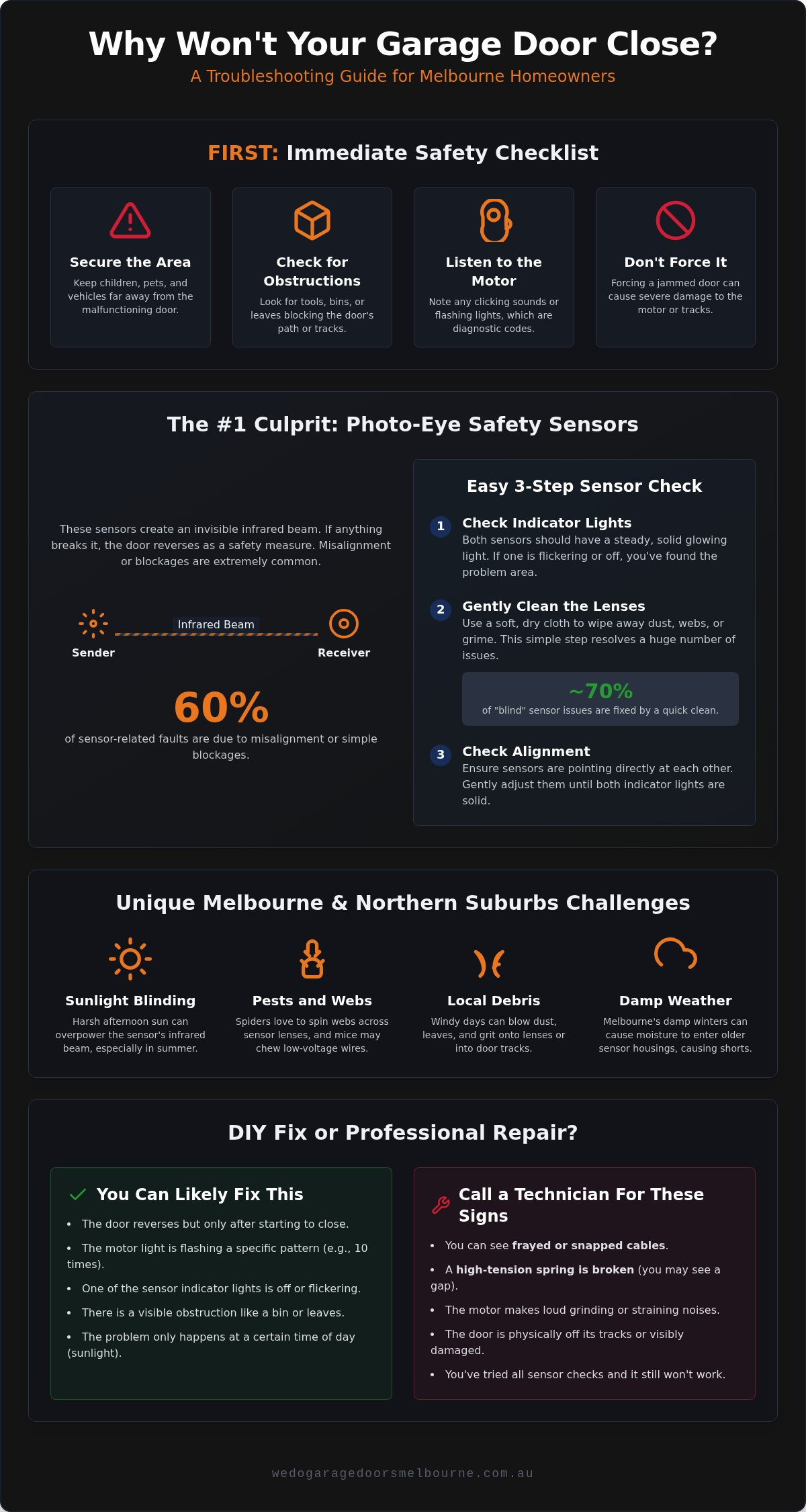
The moment your garage door refuses to shut, it's natural to feel a surge of stress. Before you attempt to fix it, the absolute priority is safety. Keep children, pets, and vehicles well away from the door opening. A malfunctioning door can be unpredictable, and if a component like a cable or spring is under tension, it poses a genuine risk. Take a deep breath and perform a quick visual scan of the area. Often, a garage door sensor not working Melbourne homeowners find is simply caused by a stray garden tool, a wheelie bin, or even a build-up of autumn leaves from a windy afternoon in the Northern Suburbs.
Listen closely to your motor unit. Is it making a distinct clicking sound? Are there lights flashing on the casing? These are diagnostic signals, not just random noises. If the door starts to close but then immediately reverses, avoid the temptation to force it down manually. If a high-tension spring has snapped, forcing the door can cause the entire system to collapse or damage the motor beyond repair. Instead, look for obvious physical obstructions in the tracks or near the base of the door before moving on to more technical checks.
The Security Risk: Protecting Your Melbourne Home
In suburbs like Craigieburn and Greenvale, an open garage door is more than an inconvenience; it's a visible invitation for opportunistic theft. If your door is stuck open, you must secure the rest of your property immediately. Most modern motors have a red manual release cord. Pulling this allows you to disengage the motor, but only do this if the door is already in the fully closed position or if you have help to support the weight. For an open door that won't budge, focus on locking the internal "shoebox" door that leads from your garage into your living space. This provides a vital secondary layer of security while you organise a professional repair.
Identifying the 'Blinking Light' Warning System
Your garage door opener is designed to tell you what's wrong. Major Australian brands like Merlin and B&D use specific flash patterns to indicate faults. For instance, a Merlin motor might flash its work light ten times to signal a safety beam obstruction. These photo-eye safety sensors are mandatory for a reason, and a blinking LED on the sensor itself usually means the beam is misaligned or blocked. Interestingly, you might find your wall-mounted button works while your remote fails. This often happens because the wall button requires a "constant pressure" override, whereas the remote relies entirely on the sensors being clear. Understanding these signals is the first step in moving from frustration to a secure, working home.
Troubleshooting the Photo-Eye Safety Sensors
When you are faced with a garage door sensor not working Melbourne technicians often find that the solution is simpler than a full motor replacement. These sensors, known as photo-eyes, are located at the base of your garage door tracks, usually about 15 centimetres off the ground. They work as a pair: one unit sends an invisible infrared beam to a receiving unit on the opposite side. If that beam is broken, the door will not close. Statistics show that misaligned or obstructed sensors account for approximately 60% of all sensor-related service calls, making this the first place you should look when your door plays up.
Start by checking the LED indicator lights on both units. In a healthy system, both lights should be glowing steadily. If one is flickering or completely dark, you have found your culprit. Before reaching for your tools, take a soft, clean cloth and gently wipe the lenses. Melbourne's wind can carry a surprising amount of dust and grit, particularly in developing areas, which easily coats these small glass eyes and "blinds" the system. A quick clean resolves nearly 70% of sensor issues, often saving you a service fee for what is essentially a ten-second maintenance task.
Common Sensor Disruptions in the Northern Suburbs
Living in the Northern Suburbs presents unique challenges for garage door technology. During the height of summer, the harsh afternoon sun can actually overpower the infrared beam, a phenomenon known as "sunlight blinding." If your door only refuses to close at a specific time of day, this is likely the cause. Additionally, keep an eye out for local pests. Spiders love to spin webs across the lenses, and occasionally, field mice in areas like Mickleham or Greenvale may chew through the low-voltage wiring. During damp Melbourne winters, moisture can also seep into older, unsealed sensor housings, causing intermittent electrical shorts that require professional attention.
Testing the Alignment: A Simple DIY Fix
If the lenses are clean but the lights are still blinking, your sensors are probably out of alignment. You can confirm this using a simple string line. Stretch a piece of string between the two sensors to ensure they are perfectly level and facing each other directly. Even a slight vibration from the door's daily operation can loosen the mounting brackets over time, causing the beam to "miss" the receiver. Tighten the wing nuts or screws on the brackets once you have them organised and level. If the lights don't return to a solid glow after these adjustments, you might be dealing with a wiring fault or a failed component. In these cases, it's safer to book an emergency garage door repair Melbourne service to ensure your home meets the necessary federal safety standards for residential openers. If you're unsure about the technical side, our team at We Do Garage Doors can quickly diagnose the fault and get your sensors back in perfect sync.
Mechanical Failures: When the Problem is Under the Hood
If you have confirmed that your safety beams are aligned and clean, yet the door still refuses to stay shut, the issue likely resides within the mechanical heart of the system. While a garage door sensor not working Melbourne is a frequent culprit, physical components like springs, cables, and motor settings eventually wear down. Troubleshooting these parts requires a keen eye for detail. Start by performing a visual inspection of the tracks. Look for any obvious bends, gaps, or debris that might be causing the rollers to bind. Often, a lack of proper lubrication causes the motor to sense too much resistance, which triggers the safety reverse mechanism as if it had hit an object.
Next, look upward at the cable drums and the high-tension springs. You are looking for two specific warning signs. First, check for "bird-nesting" on the cable drums, where the steel cables have become tangled or frayed. Second, inspect the large torsion spring for a visible gap in the coils. A gap indicates the spring has snapped and can no longer support the door's weight. These mechanical failures are often the result of Melbourne's variable climate causing metal components to expand and contract, eventually leading to fatigue in older systems.
Travel Limit Adjustments and Logic Board Errors
Sometimes a door will travel all the way to the floor and then immediately head back up. This frustrating cycle is often called "ghosting." It typically happens because the motor's "close limit" is set too far, causing the door to hit the ground with enough force to trigger the safety reverse. You can usually recalibrate these settings on modern smart garage door opener Melbourne systems using the onboard interface or a dedicated smartphone app. However, if your motor is completely unresponsive or behaves erratically after a heavy storm in the Northern Suburbs, the logic board may have suffered a power surge. This requires a professional diagnostic to determine if a repair or a full motor replacement is the most cost-effective path forward.
Broken Springs and Tangled Cables: The Danger Zone
There is a clear line between a simple DIY adjustment and a high-risk repair. If you discovered a snapped spring or a tangled cable, you have entered the danger zone. Because these parts are under immense tension, garage door spring replacement Melbourne is strictly a task for experienced technicians. You might recall hearing a loud bang from the garage earlier in the week; that was the sound of the spring failing. Attempting to fix these components yourself without the correct tools and training can lead to serious injury or further damage to your property. If the door is hanging at an angle or feels incredibly heavy to lift manually, it is time to step back and call for expert assistance.
Local Factors: Why Melbourne Homes Face Unique Issues
Melbourne's climate is famously unpredictable. Our "four seasons in one day" isn't just a talking point for the weather report; it is a major factor in why you might find your garage door sensor not working Melbourne wide. Rapid temperature shifts in Victoria cause significant expansion and contraction in metal tracks and springs. A track that was perfectly aligned during a cool morning might shift just enough by a 35 degree afternoon to cause a sensor misalignment or a binding roller. This constant movement puts a unique strain on the delicate electronics that keep your home secure.
In the Northern Suburbs, environmental debris plays a starring role in door failures. If you live in Greenvale or Mickleham, the proximity to established gum trees means bark, leaves, and twigs frequently find their way into the tracks. This debris acts as a physical barrier that can trigger the auto-reverse safety mechanism. Combined with the fine inland dust common in these areas, your track lubrication can quickly turn into a thick, abrasive paste. This grit wears down rollers and puts unnecessary strain on the motor, leading to intermittent faults that are hard to pin down without a professional eye.
Just as the climate impacts your garage door components, it also affects the concrete surfaces they rest upon. For homeowners looking to maintain their property's overall structural integrity and curb appeal, Inspire Concrete provides comprehensive resources on driveway resurfacing and long-term maintenance that are valuable regardless of your location.
Suburban Specifics: From Craigieburn to Roxburgh Park
The type of door you have often depends on the age of your suburb. In the newer estates of Craigieburn, modern sectional doors are the standard. While these are reliable, their multiple moving parts and hinges require precise tensioning to stay functional. Conversely, in more established pockets of Roxburgh Park, you might still have an older tilt door. These heavy, single-panel doors rely on massive side springs that are prone to fatigue. Regardless of the door type, the best way to avoid a mid-winter breakdown is to book an annual garage door service Melbourne homeowners trust to keep their systems running smoothly. If you've noticed your door becoming noisier or jerkier, contact our team for a professional check-up before a minor issue becomes a total failure.
Smart Technology Upgrades for Better Reliability
As we move through 2026, many Melbourne homeowners are upgrading to smart technology to bypass traditional reliability issues. New builds in Wollert often experience electrical interference from a high density of smart devices, which can occasionally scramble the signal of older remote controls. Modern WiFi-enabled systems solve this by using encrypted, multi-frequency signals. These systems also provide real-time alerts to your smartphone if the door is left open, providing peace of mind when you're at work or away for the weekend. Perhaps most importantly, these newer motors often include battery backup units. This ensures that even during the occasional Northern Suburb power outage, you won't be locked out of your own home. Integrating your door into a wider home security network ensures that your garage is no longer the "weak link" in your property's protection.
When to Call a Professional Melbourne Technician
While the simple checks we've discussed often resolve a minor glitch, there are moments when a DIY approach becomes a genuine safety hazard. If you have followed our guide and still find your garage door sensor not working Melbourne residents often discover that the fault lies deeper in the electrical circuit or motor logic. There are specific "red flag" symptoms that indicate your door requires the attention of a master technician. A door that is physically off the tracks or hanging at a precarious angle is an immediate emergency. In this state, the structural integrity of the system is compromised, and any further attempt to operate the motor could cause the door to fall completely, risking injury or significant property damage.
You should also step back and call for help if you identify any of the following issues:
Visible Mechanical Damage: You can see a clear break in the high-tension torsion springs or a cable that has snapped and is trailing on the garage floor.
Motor Distress: The motor unit is making a loud grinding, straining, or whirring noise while the door remains stationary or jerky.
Unresponsive Sensors: You have cleaned and aligned the photo-eyes, but the LED indicator lights remain dark or continue to blink.
Heavy Operation: The door feels incredibly heavy to lift manually or won't stay in the half-open position when the motor is disengaged.
The 'We Do Garage Doors' Difference
At We Do Garage Doors, we understand that a door that won't shut is a major security breach for your family. That is why we specialise in garage door repairs Melbourne homeowners can rely on for same-day results. Our master technicians possess deep technical expertise across all major brands, including Merlin, B&D, and Chamberlain systems. We don't believe in temporary patches that only last a few weeks. Instead, we focus on identifying the root cause of the malfunction. Whether it is a failed logic board or a hidden wiring break causing your garage door sensor not working Melbourne experts from our team ensure a long-term fix that preserves the lifespan of your motor.
Booking Your Service Call: What to Expect
When you book a service call for your Northern Suburbs home, you can expect transparent communication and professional hospitality from the first hello. We use precise diagnostic tools to pinpoint the exact failure, avoiding the guesswork that leads to unnecessary costs. Our team prioritises urgent security-related calls in Greenvale, Mickleham, and Wollert, ensuring your home is never left vulnerable overnight. Before our technician leaves your driveway, we perform a comprehensive safety check. This includes ensuring the door is perfectly balanced, the tracks are lubricated, and the auto-reverse safety mechanism is fully compliant with 2026 Australian standards. We value the human connection behind our work and take pride in leaving every client feeling secure, informed, and respected.
Restoring Your Home's Security and Peace of Mind
Dealing with a garage door that won't close is a stressful disruption, but many issues can be resolved with a calm and methodical approach. Whether it's a simple case of a garage door sensor not working Melbourne homeowners can often fix the problem by clearing away local debris or realigning a mounting bracket. If you have identified a more serious mechanical red flag, such as a snapped spring or a grinding motor unit, it's vital to prioritise your safety and your property's security by calling in the experts.
Our master garage door technicians are dedicated to providing the reliable, expert care your home needs. We provide same-day service throughout the Northern Suburbs and are specialists in modern smart motor upgrades that offer enhanced long-term reliability. We take pride in our craft and value the trust you place in us to keep your family safe. Secure your home today-book a rapid Melbourne repair service and let us handle the technical details while you get back to your busy day. We are always here to help you maintain a secure and effortless lifestyle.
Frequently Asked Questions
Why is my garage door light flashing and the door won't close?
A flashing light on your motor unit is typically a diagnostic signal indicating that the safety sensors have detected an obstruction or have lost alignment. Most major Australian brands, such as Merlin or B&D, use specific flash patterns to communicate these errors. It's a built-in safety feature designed to prevent the door from closing on a person or vehicle. Check the floor area for objects or dust on the sensor lenses to clear the fault.
Can I bypass the safety sensors to close my garage door manually?
You can often bypass the sensors by holding down the wall-mounted control button until the door is fully closed. This "constant pressure" override is a standard safety feature for emergencies. Alternatively, you can pull the red manual release cord to disengage the motor and slide the door down by hand. Be extremely careful when doing this; the door will be heavy if it's not properly balanced or if a spring is broken.
How do I know if my garage door motor needs replacing or just a repair?
A repair is usually sufficient if the issue involves minor components like stripped gears, faulty remotes, or a garage door sensor not working Melbourne climate issues. However, if the motor's logic board has been fried by a power surge or if the unit is over 15 years old and making excessive grinding noises, a full motor replacement is often the most cost-effective and reliable long-term solution for your home's security.
Is it safe to close a garage door with a broken spring?
It is not safe to operate a garage door with a broken spring, even manually. The springs do the heavy lifting; without them, the door becomes a dead weight that can crash down unexpectedly or cause the motor to burn out. If you see a visible gap in your torsion spring, leave the door exactly where it is and avoid touching the release cord. This is a high-pressure mechanical failure that requires a professional technician to resolve safely.
Why does my garage door close halfway and then go back up?
This behaviour is often caused by incorrect "travel limit" settings or excessive resistance in the tracks. If the motor senses a slight bind or a bump in the track, it assumes it has hit an obstacle and reverses for safety. This is common in Melbourne when tracks shift due to temperature changes. You may need to clean the tracks and apply a silicone-based lubricant or recalibrate the close limits on your motor's control panel.
How much does an emergency garage door repair call-out cost in Melbourne?
Emergency call-out fees in Melbourne vary depending on the time of day and the complexity of the fault. Most reputable local companies will provide a clear diagnostic fee before beginning any work. While simple sensor alignments are generally more affordable, major mechanical repairs involving parts like springs or cables will involve additional costs. It's always best to check with your technician about their specific service rates and any potential parts required for your suburb.
Can sunlight really stop my garage door from closing?
Yes, direct sunlight can "blind" the infrared safety beams, especially during a bright Melbourne afternoon. If the sun hits the receiving sensor at a specific angle, it can overpower the signal from the sending unit. This makes the system believe there is an obstruction in the way. You can often fix this by creating a small cardboard sunshade for the sensor or by slightly adjusting its angle so it sits deeper in the shadow of the track.
What should I do if my garage door cable has snapped?
If a cable has snapped, you must stop using the door immediately and keep everyone away from the area. The cables work in tandem with the springs to keep the door level and controlled. When one fails, the door may hang at a dangerous angle or fall without warning. Do not attempt to pull the manual release cord, as the door could drop instantly. This is a critical mechanical failure that requires a master technician to repair safely.


Comments