

Automatic Garage Door Troubleshooting: The 2026 Melbourne Homeowner’s Guide
Updated: Jul 19
It is 7:15 AM on a Monday in Melbourne, and you are already behind schedule when your garage door suddenly lets out a sharp, metallic groan and stops exactly halfway up. It's a sinking feeling every homeowner knows well. Whether your car is stuck inside before a school run or your remote refuses to respond despite fresh batteries, a malfunctioning door is a major disruption to your day. We understand the stress these mechanical hiccups cause, which is why we have put together this guide on automatic garage door troubleshooting to help you regain your peace of mind.
Our goal is to help you handle these frustrations with professional confidence and clarity. You will learn how to safely diagnose common faults, understand the latest 2026 safety standards for smart openers, and recognise the exact moment you should step back and call a master technician to keep your home secure. We'll cover everything from simple sensor alignments to identifying those scary grinding noises that signal a more serious issue. By the end of this guide, you'll have a clear path from a stuck door back to a seamless, effortless routine.
Table of Contents
First Steps: Why Your Automatic Garage Door Isn’t Responding
When you press your remote and hear nothing but silence, it's easy to assume the worst. Before you start worrying about a total motor failure, take a breath. Most automatic garage door troubleshooting begins with a few simple checks that don't require any tools at all. Often, the solution is right in front of you, hidden in a simple setting or a loose plug. We want to help you clear away the easy fixes so you can get on with your day in Melbourne without unnecessary stress.
Checking the Power Supply and Manual Release
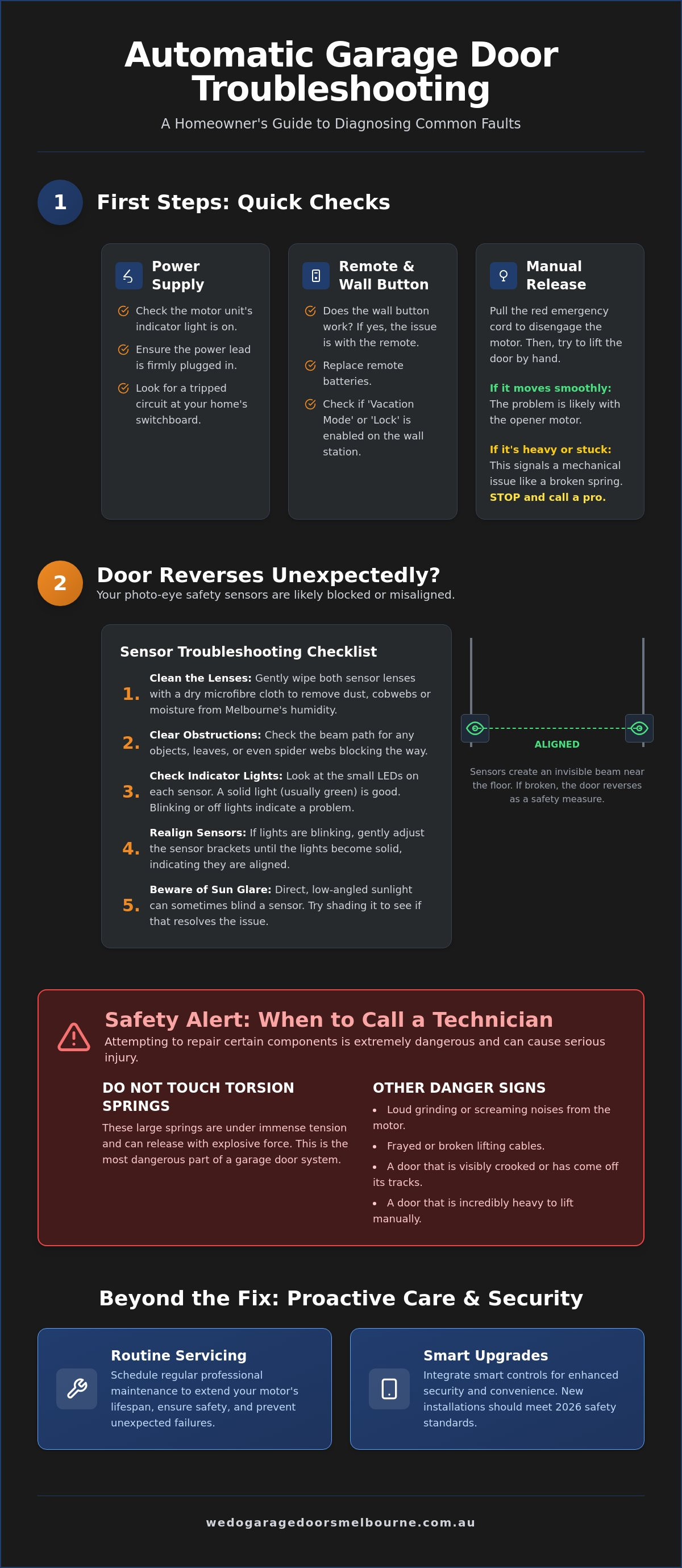
Your first move should always be to look up at the motor unit mounted on your garage ceiling. Is there an indicator light glowing? If the unit looks completely dead, it might simply be a power issue. Check that the power lead is firmly plugged into the ceiling socket. If it is, head over to your home's main switchboard. A tripped circuit breaker is a common culprit, especially after one of our famous Melbourne afternoon storms or a sudden power surge. If the breaker has flipped, click it back on and try the door again. For broader home electrical issues or wiring repairs, electricalrepair4u.com provides professional support to ensure your property remains powered and secure.
If the power is fine but the motor is straining without moving the door, it's time to check the manual release. Every automatic system has a red emergency cord. Pulling this cord disengages the motor from the door, allowing you to move it by hand. This is a vital safety feature for when you're stuck during a blackout. Once disengaged, try to lift the door manually. It should move smoothly and stay in place when half-open. If the door feels incredibly heavy or won't budge, you aren't dealing with a motor fault; you likely have a mechanical blockage or a broken spring that needs professional attention from Brimbank Garage Doors & Repairs.
Testing the Remote Control and Wall Button
In some cases, the issue is signal interference. Modern LED globes installed near the motor can sometimes emit radio frequency interference that jams the remote's signal. Understanding how garage door openers work reveals that these devices rely on clear radio paths to function correctly. If you've recently changed your garage lighting and your remote range has dropped, the globes might be the problem. If everything else fails, your remote might simply need re-coding to the motor. This is a straightforward process of syncing the two devices, which often restores the seamless, effortless operation you expect from your home's entry point.
Eliminating Obstacles: Photo-Eye Sensors and Track Alignment
If your door starts to close but suddenly reverses with a flash of the motor lights, you are likely witnessing the safety system in action. This "reversal" feature is your door’s most sensitive component, designed to prevent the heavy door from crushing anything in its path. These systems are built to meet rigorous federal safety standards, ensuring that your home remains a safe environment for children and pets. However, because these sensors are so vital, they are also incredibly finicky.
In Melbourne, our "four seasons in one day" climate plays a significant role in how these sensors behave. High humidity or sudden temperature shifts can cause condensation to form on the sensor lenses, effectively blinding the infrared beam. When you are performing automatic garage door troubleshooting, always start by checking the environment around the base of your tracks. A single spider web or a coating of morning dew can be enough to trigger a full system stop, leaving you frustrated at the driveway gate.
Cleaning and Realigning Safety Sensors
Start by wiping both sensor lenses with a dry microfibre cloth. This simple step removes the dust and cobwebs that frequently accumulate near the floor. Next, check the small LED indicator lights on the side of each sensor. Typically, a solid green light means the path is clear, while a red or blinking light indicates a blockage or misalignment. If the lights are blinking, gently adjust the pivot brackets until the beams are perfectly centred again. Be mindful of the afternoon sun; in certain Melbourne suburbs, the low-angled sun can "wash out" the sensor's receiver, making the motor think there is an obstruction when it's actually just sun glare.
Inspecting Tracks for Debris and Dents
Your garage door tracks act as the highway for your rollers, and even a tiny pebble can cause a major traffic jam. Use a stiff brush to clear out dried grease, dirt, and small stones from both the vertical and horizontal tracks. While you're there, perform a visual check for any "crimped" or bent sections. A dented track can catch a roller and force the motor to stop to prevent damage. If you notice significant bending or if the door still feels sticky, it might be time to book a professional inspection. Avoid the temptation to use heavy automotive grease on your tracks; it only attracts more Melbourne dust. Instead, a light application of silicone-based lubricant will keep the rollers gliding effortlessly.
Effective automatic garage door troubleshooting is often about these small, methodical observations. By keeping your tracks clear and your sensors clean, you ensure your door operates with the precision and reliability you deserve.
Decoding the Motor: Troubleshooting Your Garage Door Opener
The motor is the heart of your system, acting as the "brains" that coordinate every movement. When things go wrong here, automatic garage door troubleshooting takes a more technical turn. Modern openers are equipped with logic boards that monitor everything from door weight to travel distance. If yours is acting up, look for blinking lights or listen for specific beeping patterns. These are actually diagnostic codes designed to meet the federal consumer product safety standard, helping you identify if the issue is a simple software glitch or a hardware failure. It's our way of ensuring your home remains secure while we work to find a solution.
Resetting the Motor and Adjusting Limit Settings
Sometimes the logic board just needs a fresh start. We recommend the "unplug and wait" method; simply disconnect the power for sixty seconds to clear temporary glitches. If your door closes, hits the floor, and immediately pops back up, your "close limit" likely needs adjusting. This setting tells the motor exactly where the floor is. Over time, or as Melbourne's weather causes the metal components to expand and contract, these limits can drift slightly. For popular local brands like Merlin, the reset sequence involves a specific button pattern on the unit itself. Fine-tuning the force settings during this process can also help the motor compensate for a door that has become slightly stiffer due to seasonal temperature changes. It is a methodical way to restore that smooth, effortless operation you've come to expect.
Identifying Unusual Noises and Motor Burnout
The sounds your motor makes are its way of telling you what is happening under the hood. A loud, sharp grinding noise usually points to a stripped nylon drive gear inside the housing. This often happens if the motor has been working too hard for too long against a heavy, unbalanced door. If you hear a dull humming sound but the door doesn't move at all, you are likely looking at a failed capacitor or a seized motor assembly. While some components can be swapped out—much like how homeowners might source specific appliance spares from Hvidevaredele.dk for other DIY repairs—there comes a point where a garage door motor replacement Melbourne is the more cost-effective and reliable path. Newer models offer better security features and significantly quieter operation, turning a stressful breakdown into a long-term home upgrade that provides lasting peace of mind.
Distinguishing between a minor electronic hiccup and a total mechanical failure is the key to effective automatic garage door troubleshooting. By listening to the motor and observing its behaviour, you can make an informed decision about whether a simple reset will do the trick or if it's time to invest in a more modern, durable solution for your Melbourne home.
The Danger Zone: When Troubleshooting Becomes a Safety Risk
While most automatic garage door troubleshooting involves simple cleaning or battery swaps, there is a hard line where DIY efforts become genuinely dangerous. Your garage door is likely the largest moving object in your Melbourne home, and it relies on massive amounts of stored energy to function. Understanding which parts are safe to touch and which are strictly "hands-off" is crucial for your personal safety and the long-term security of your property. We want to help you stay informed so you can make the right call when a situation moves beyond a simple fix.
Identifying Snapped Springs and Frayed Cables
Look up at the metal bar located directly above your door opening. If you see a clean break or a visible gap in the tightly coiled horizontal torsion spring, stop what you are doing immediately. This spring is responsible for counterbalancing the entire weight of the door. When it snaps, the door becomes a "dead weight" that can weigh well over 100 kilograms. You might have heard a loud "bang" echoing from the garage earlier, which is the tell-tale sound of a spring failing under pressure.
Never attempt the "Heavy Door Test" by forcing your motor to lift a door with a broken spring. As we discussed in the previous section, this will quickly burn out the logic board or strip the internal gears. Similarly, inspect the "silver" lift cables running down the sides of the door. If you notice even a single loose strand or visible fraying, it's a ticking time bomb. These cables are under immense tension; if one snaps while the door is in motion, the entire unit can fall crookedly, potentially crushing anything beneath it or causing catastrophic damage to your tracks.
Why DIY Spring Adjustment is a No-Go in Melbourne
The torque required to wind a garage door spring is incredible. Professional technicians use specialised solid steel winding bars and undergo extensive training to manage this energy safely. A common and dangerous DIY mistake involves using screwdrivers or pliers to adjust these springs. These tools can easily slip, leading to a "flywheel" effect where the spring unwinds with enough force to cause severe injury. It simply isn't worth the risk to your well-being when expert help is available.
If you've found your door won't lift more than a few centimetres or you've spotted a broken component, you should call for an emergency garage door repair Melbourne service. We take great pride in handling these high-pressure components with technical mastery, ensuring your home remains a safe environment for your family. Don't risk a serious accident by trying to "just tighten" a high-tension part yourself. For your peace of mind and safety, contact our expert team today to organise a professional inspection and repair.
Beyond the Fix: Professional Servicing and Smart Upgrades
Mastering automatic garage door troubleshooting is an excellent first step, but the real secret to a stress-free home is moving from reactive repairs to proactive care. Think of your garage door like your car; it is a heavy machine with hundreds of moving parts that require regular attention to stay in peak condition. By shifting your focus to preventative maintenance, you ensure that those scary grinding noises and sudden stops we discussed earlier never become a reality in your Melbourne driveway. It is about creating a seamless transition from a state of potential malfunction to one of total ease and security.
The Benefits of an Annual Garage Door Service
A professional service is about much more than just a quick check-up. It involves deep lubrication of all moving parts, including hinges, rollers, and those high-tension springs that carry the heavy lifting. Over time, Melbourne's dust and fluctuating moisture levels can cause these components to seize or wear unevenly. A certified technician will also rigorously test the "Auto-Reverse" safety system to ensure it meets current Australian standards, protecting your family and vehicles from accidental impact. Investing in an annual garage door service Melbourne is a smart financial move. Catching a small alignment issue early often prevents catastrophic motor failures that can cost upwards of $1,000 to replace, providing you with long-term peace of mind.
In addition to mechanical upkeep, maintaining a comfortable internal environment is a priority for many Melbourne residents. If you are considering an upgrade to your home's climate control, you can discover Nature Carer Environmental Solutions for professional air conditioning installations.
Upgrading to Smart Door Control Systems
Modernising your home does not just add value; it removes the daily "is my door open?" anxiety that plagues many homeowners. Smart control technology allows you to monitor and operate your door from anywhere in the world using your smartphone. If you have ever turned the car around halfway to work just to check the door, this is the solution for you. These systems integrate with Google Home or Apple HomeKit, allowing for hands-free voice commands and real-time activity logs that notify you the moment your door is accessed, while further exterior enhancements from pergola2go.com can complete your home’s outdoor transformation.
Sometimes, smart systems face their own unique hurdles, such as Wi-Fi signal drops in brick garages or app sync errors after a software update. Most of these "smart" faults can be resolved by checking your home's router range or resetting the bridge unit. If you are looking for a more permanent solution with better reliability, considering a smart garage door opener Melbourne ensures you have the latest hardware built for unattended operation. This proactive approach to automatic garage door troubleshooting means you spend less time worrying about your hardware and more time enjoying the effortless, secure lifestyle you deserve. Just as home systems benefit from technical clarity, business owners can achieve similar results in their operations by partnering with Business Analysis & Solutions for expert ICT and digital strategy consultancy.
Securing Your Home and Your Peace of Mind
Navigating automatic garage door troubleshooting doesn't have to be a source of stress. By starting with simple power checks and keeping your sensors clear of Melbourne’s morning dew, you can often resolve minor glitches on your own. However, your safety is the ultimate priority. When you encounter snapped springs or frayed cables, the best move is to rely on professional expertise rather than risking a dangerous DIY accident.
If your door still isn't behaving or you would like the certainty of a master technician's eye, we are here to help. Our team brings over eight years of local experience to every driveway, and we are specialists in Merlin and B&D motor systems. We provide emergency same-day repairs across Melbourne’s Northern Suburbs to ensure your day stays on track. Book a Professional Service Call with We Do Garage Doors today to restore the effortless, secure operation of your home. You've got this, and we're just a phone call away if you need a hand.
Frequently Asked Questions
Why is my garage door opening back up as soon as it hits the floor?
Your door is likely reversing because the "close limit" settings are telling the motor to travel further than the floor actually allows. When the door meets the ground before the motor expects it, the safety system perceives the floor as an obstruction and pops back up to prevent damage. You can usually fix this by slightly adjusting the limit screws on your motor unit to define a more accurate stopping point.
Can I still use my automatic garage door if the power is out?
You can certainly operate your door manually by pulling the red emergency release cord to disengage the motor from the rail. This allows you to lift and lower the door by hand until the power returns to your Melbourne home. Once the electricity is back on, simply push the lever back into place or pull the cord toward the door to re-engage the automatic system for normal use.
How often should I lubricate my automatic garage door tracks?
We recommend a light application of silicone-based lubricant every six months to keep your system running quietly and smoothly. It's a common mistake to use heavy grease or WD-40, but these actually attract dust and grit that can clog your rollers over time. Focus your spray on the hinges, rollers, and springs rather than the inside of the tracks to ensure the best results for your hardware.
What does it mean if my garage door motor is beeping?
A beeping motor is typically a diagnostic alert indicating that your battery backup is low or there is a specific hardware fault that needs attention. Most modern openers use these audible signals as a way to communicate internal errors without you needing to open the casing. Check your user manual for the specific beep sequence, as it will tell you if you simply need a new battery or a technician's visit.
Is it safe to replace a garage door cable myself?
It is not safe to replace a garage door cable yourself because these components are under extreme tension from the counterbalancing springs. If a cable snaps or is released incorrectly during a DIY attempt, it can cause severe physical injury or significant damage to your garage. This is a critical point where automatic garage door troubleshooting should stop and a qualified professional should be called to handle the high-pressure hardware.
Why does my garage door only open halfway and then stop?
This issue is often caused by a physical blockage in the tracks or travel limit settings that have drifted out of alignment. Check the vertical and horizontal tracks for any bent sections, loose bolts, or debris that might be catching the rollers as they move. If the path is completely clear, you may need to recalibrate the "open limit" on your motor unit to ensure it understands the full height of the opening.
How do I know if my garage door springs need replacing?
You will know your springs have failed if you see a visible gap in the metal coils or if the door feels incredibly heavy when you try to lift it manually. A loud, sharp "bang" coming from the garage is often the first sign that a spring has snapped under tension. If your door won't stay open halfway when you disengage the motor, the springs are likely fatigued and require a professional replacement.
My remote works from inside the garage but not the driveway—what is wrong?
This range issue is usually caused by signal interference or a weak battery that doesn't have the strength to transmit through the garage door. Certain LED globes or nearby electronic devices can sometimes "jam" the radio frequency, making automatic garage door troubleshooting a bit more complex. Try replacing the remote battery first, and if that doesn't work, consider switching to high-quality, shielded LED globes to clear the signal path for your remote.


Comments